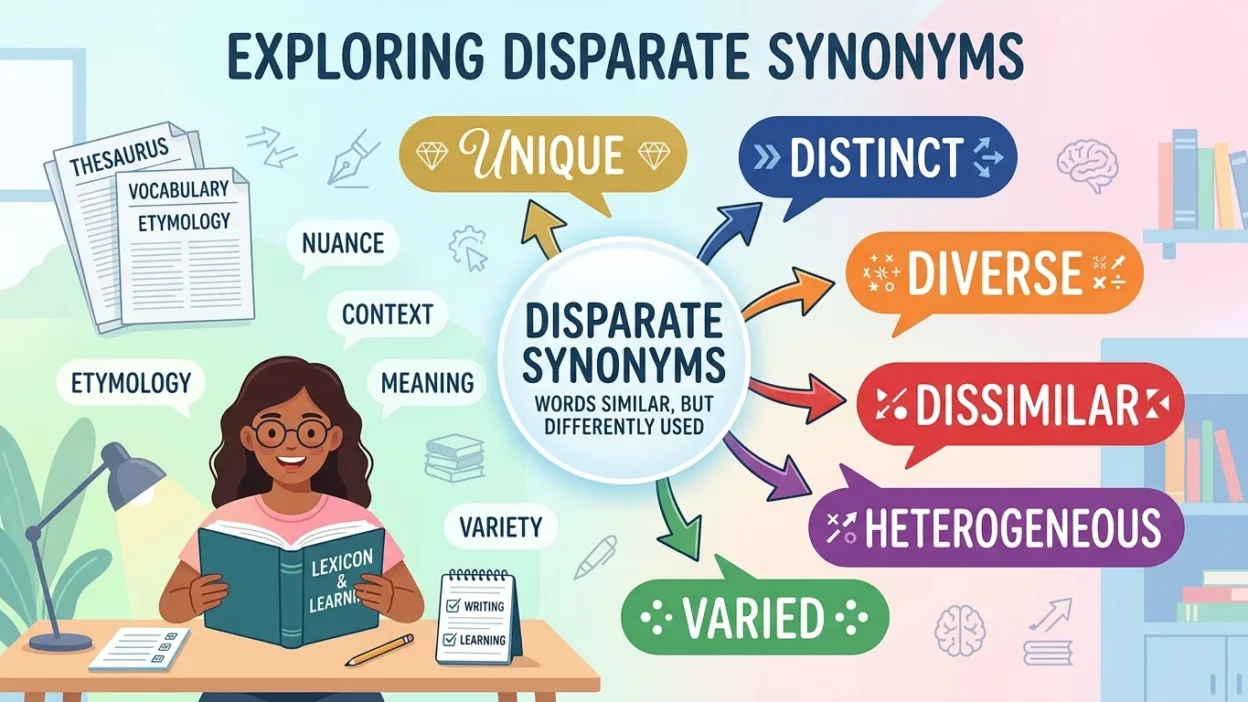
Understanding vocabulary is not just about knowing words it’s about knowing the right word for the right moment. If you’ve ever searched for disparate synonyms, chances are you want to express subtle differences in meaning more clearly. This is especially important for students, ESL learners, writers, and content creators who want their language to feel natural and precise.
The word disparate itself refers to things that are very different from each other. But learning synonyms especially for nuanced words like demure helps you build a richer vocabulary and communicate tone more effectively. In this guide, we’ll explore the meaning of demure and provide 30 carefully explained synonyms, each with examples and usage tips.
What Does “Demure” Mean?
Demure describes someone (usually a woman, but not always) who is quiet, modest, shy, or reserved in behavior and appearance.
Simple Meaning:
A person who is calm, polite, and not loud or attention seeking.
Tone & Usage:
- Positive: polite, graceful, respectful
- Neutral: quiet or reserved
- Sometimes slightly old fashioned depending on context
Example:
She gave a demure smile and quietly thanked everyone.
30 Synonyms of “Demure” (With Meanings, Examples & Usage)
1. Modest
Meaning: Not showing off; simple and respectful
Example: She wore a modest dress to the event.
Best Use: Formal or respectful settings
2. Reserved
Meaning: Quiet and keeps feelings private
Example: He is reserved around strangers.
Best Use: Personality descriptions
3. Shy
Meaning: Nervous or uncomfortable socially
Example: The shy girl avoided eye contact.
Best Use: Informal, everyday use
4. Quiet
Meaning: Not loud or talkative
Example: She remained quiet during the meeting.
Best Use: General situations
5. Timid
Meaning: Lacking confidence or courage
Example: The timid child stayed behind.
Best Use: Emotional tone
6. Meek
Meaning: Gentle and easily controlled
Example: He spoke in a meek voice.
Best Use: Slightly negative tone
7. Soft spoken
Meaning: Speaking gently and calmly
Example: She is soft spoken but confident.
Best Use: Positive personality trait
8. Introverted
Meaning: Prefers solitude over socializing
Example: He is introverted and enjoys reading.
Best Use: Psychological context
9. Polite
Meaning: Showing good manners
Example: She gave a polite response.
Best Use: Formal tone
10. Well mannered
Meaning: Behaves properly
Example: The child is well mannered.
Best Use: Social behavior
11. Graceful
Meaning: Elegant and smooth in behavior
Example: She walked in a graceful way.
Best Use: Positive, elegant tone
12. Ladylike
Meaning: Traditionally feminine and polite
Example: She maintained a ladylike posture.
Best Use: Cultural/formal context
13. Gentle
Meaning: Kind and calm
Example: He has a gentle personality.
Best Use: Emotional tone
14. Subdued
Meaning: Quiet and controlled
Example: The crowd was subdued.
Best Use: Situational tone
15. Unassuming
Meaning: Not trying to impress
Example: He is unassuming despite success.
Best Use: Positive modesty
16. Reticent
Meaning: Not speaking much
Example: She was reticent in class.
Best Use: Formal writing
17. Coy
Meaning: Shy in a playful or teasing way
Example: She gave a coy smile.
Best Use: Romantic context
18. Bashful
Meaning: Easily embarrassed
Example: The bashful boy blushed.
Best Use: Friendly tone
19. Humble
Meaning: Not proud or arrogant
Example: He remained humble.
Best Use: Positive character
20. Composed
Meaning: Calm and controlled
Example: She stayed composed under pressure.
Best Use: Professional tone
21. Discreet
Meaning: Careful and private
Example: Be discreet about this matter.
Best Use: Confidential situations
22. Mild
Meaning: Not strong or aggressive
Example: He has a mild nature.
Best Use: Personality
23. Simple
Meaning: Plain and not fancy
Example: She prefers simple clothing.
Best Use: Lifestyle context
24. Calm
Meaning: Peaceful and not excited
Example: She remained calm.
Best Use: General tone
25. Low key
Meaning: Relaxed and not showy
Example: It was a low key event.
Best Use: Informal tone
26. Restrained
Meaning: Controlled behavior
Example: He gave a restrained reaction.
Best Use: Formal writing
27. Proper
Meaning: Correct and respectful
Example: She behaved in a proper manner.
Best Use: Formal/social norms
28. Decent
Meaning: Respectable and appropriate
Example: He wore decent clothes.
Best Use: Everyday tone
29. Self effacing
Meaning: Not drawing attention to oneself
Example: She is self effacing.
Best Use: Advanced vocabulary
30. Understated
Meaning: Simple but elegant
Example: The design is understated.
Best Use: Style and fashion
Comparison Guide: Choosing the Right Synonym
| Situation | Best Synonyms |
| Formal writing | Reserved, Reticent, Composed |
| Friendly conversation | Shy, Quiet, Bashful |
| Positive personality | Gentle, Humble, Graceful |
| Romantic tone | Coy, Soft spoken |
| Professional setting | Discreet, Restrained |
| Casual context | Low key, Calm |
How to Choose the Right Synonym
Choosing the correct word depends on tone and intent. Here’s a simple guide:
1. For Politeness & Respect
Use: Modest, Polite, Well mannered
2. For Shyness or Social Behavior
Use: Shy, Bashful, Timid
3. For Quiet Strength
Use: Composed, Calm, Gentle
4. For Formal or Academic Writing
Use: Reticent, Restrained, Discreet
5. For Style & Elegance
Use: Graceful, Understated, Ladylike
Why Learning Synonyms Matters (Especially Disparate Synonyms)
When you explore disparate synonyms, you learn how words differ in tone, emotion, and context. Even though many words may seem similar, each carries a slightly different meaning. This helps you:
- Write more clearly
- Avoid repetition
- Sound more natural
- Express emotions precisely
Conclusion
Mastering synonyms like those for demure is a powerful way to improve your vocabulary and communication skills.
While many words may appear similar, their subtle differences matter. By understanding these distinctions especially when dealing with disparate synonyms you can choose words more confidently and effectively.
Keep practicing, read widely, and try using new synonyms in your daily writing. Over time, your language will become more natural, expressive, and impactful.