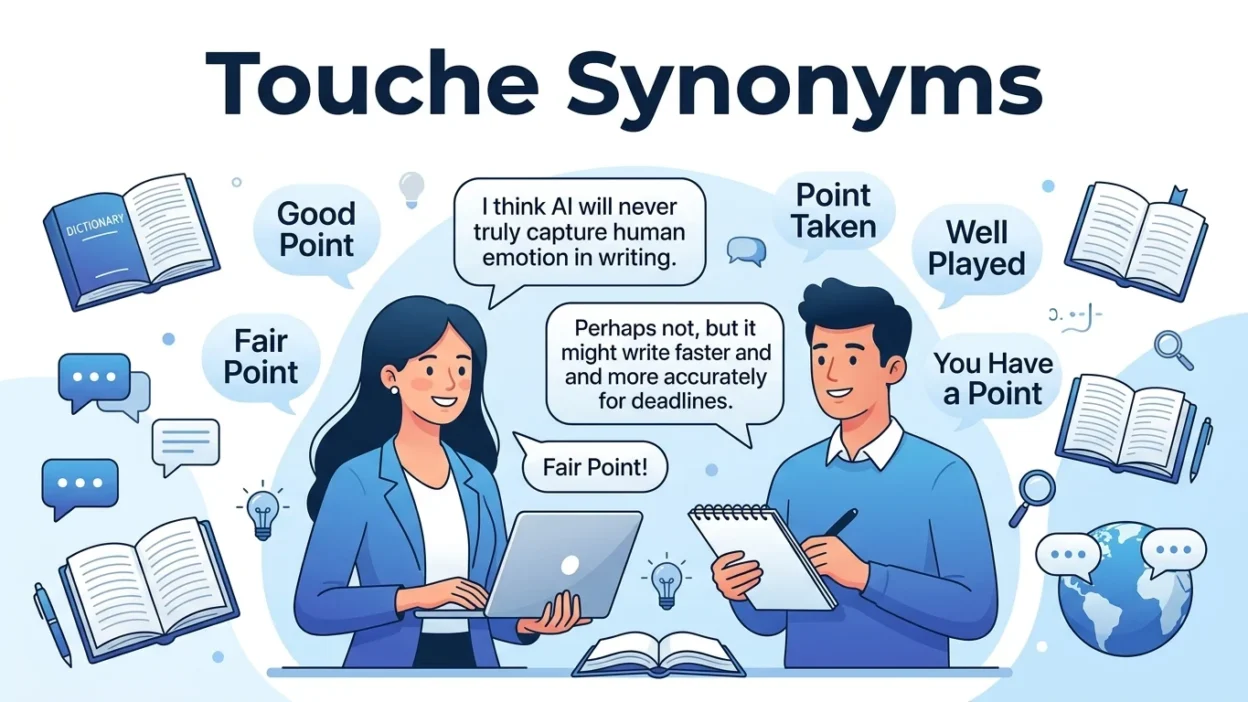
The word “touché” is a popular expression used in conversations when someone makes a clever point, wins an argument, or highlights a truth that is difficult to deny. It comes from French and literally means “touched,” but in English, it is commonly used to acknowledge a good comeback or a valid point.
Learning touché synonyms can help students, ESL learners, writers, and content creators express the same idea in different ways. Using alternative words and phrases also makes your writing and conversations more interesting and natural.
In this guide, you will learn the meaning of touché, discover 30 useful synonyms, understand their usage, and learn how to choose the right one for different situations.
What Does “Touché” Mean?
Touché is an expression used when someone makes a strong argument, clever observation, or successful comeback that you cannot easily disagree with.
Simple Meaning
Acknowledging that another person has made a valid point or won a verbal exchange.
Tone
- Respectful
- Humorous
- Friendly
- Conversational
Common Usage Context
People often say “touché” during debates, discussions, jokes, or friendly arguments when they admit the other person has made a good point.
Example:
Person A: “You always tell me to arrive on time, but you’re late today.”
Person B: “Touché.”
30 Touche Synonyms
1. Good Point
Meaning: Acknowledging a valid observation.
Example Sentence: That’s a good point; I hadn’t considered that.
Best Usage Context: Everyday conversations and discussions.
2. Fair Point
Meaning: Accepting that someone has made a reasonable argument.
Example Sentence: Fair point; your explanation makes sense.
Best Usage Context: Casual debates and workplace discussions.
3. Well Said
Meaning: Expressing approval of someone’s statement.
Example Sentence: Well said; I completely agree.
Best Usage Context: Speeches, presentations, and conversations.
4. You Got Me
Meaning: Admitting that someone has successfully challenged you.
Example Sentence: You got me there; I can’t argue with that.
Best Usage Context: Friendly arguments and jokes.
5. Valid Observation
Meaning: Recognizing an accurate remark.
Example Sentence: That’s a valid observation about the issue.
Best Usage Context: Professional and academic discussions.
6. True Enough
Meaning: Agreeing that something is largely correct.
Example Sentence: True enough, that situation could have been avoided.
Best Usage Context: Informal conversations.
7. I Stand Corrected
Meaning: Admitting that you were mistaken.
Example Sentence: I stand corrected; your information is accurate.
Best Usage Context: Formal discussions and debates.
8. Agreed
Meaning: Showing acceptance of another person’s point.
Example Sentence: Agreed; that’s the best solution.
Best Usage Context: Business and casual conversations.
9. Point Taken
Meaning: Acknowledging someone’s argument.
Example Sentence: Point taken; I’ll keep that in mind.
Best Usage Context: Professional communication.
10. You’re Right
Meaning: Directly admitting someone’s correctness.
Example Sentence: You’re right; I should have checked first.
Best Usage Context: Everyday communication.
11. Absolutely
Meaning: Strong agreement.
Example Sentence: Absolutely, that’s an excellent idea.
Best Usage Context: Positive discussions.
12. Indeed
Meaning: Confirming a statement.
Example Sentence: Indeed, the results were impressive.
Best Usage Context: Formal writing and speech.
13. Correct
Meaning: Confirming accuracy.
Example Sentence: Correct; that’s exactly what happened.
Best Usage Context: Educational and professional settings.
14. Exactly
Meaning: Showing complete agreement.
Example Sentence: Exactly; that’s what I was trying to explain.
Best Usage Context: Daily conversations.
15. Well Played
Meaning: Admitting someone made a clever move or comment.
Example Sentence: Well played; that was a smart response.
Best Usage Context: Games and humorous exchanges.
16. Nicely Done
Meaning: Praising a successful point or action.
Example Sentence: Nicely done; that was a convincing argument.
Best Usage Context: Informal praise.
17. Fair Enough
Meaning: Accepting another person’s viewpoint.
Example Sentence: Fair enough; I understand your reasoning.
Best Usage Context: Casual discussions.
18. That’s True
Meaning: Agreeing with a statement.
Example Sentence: That’s true; experience matters.
Best Usage Context: Everyday communication.
19. No Argument There
Meaning: Admitting agreement without resistance.
Example Sentence: No argument there; you’re correct.
Best Usage Context: Friendly conversations.
20. You Have a Point
Meaning: Recognizing a reasonable argument.
Example Sentence: You have a point about the deadline.
Best Usage Context: Discussions and negotiations.
21. I Can’t Deny That
Meaning: Admitting something is true.
Example Sentence: I can’t deny that your evidence is convincing.
Best Usage Context: Debates and conversations.
22. That’s Fair
Meaning: Accepting a reasonable statement.
Example Sentence: That’s fair; I understand your concern.
Best Usage Context: Professional and casual settings.
23. Conceded
Meaning: Formally admitting another person is correct.
Example Sentence: He conceded that the argument was valid.
Best Usage Context: Formal debates.
24. Acknowledged
Meaning: Recognizing the validity of a statement.
Example Sentence: The manager acknowledged the team’s concerns.
Best Usage Context: Business communication.
25. Good Catch
Meaning: Praising someone for noticing something important.
Example Sentence: Good catch; I missed that detail.
Best Usage Context: Teamwork and editing.
26. That’s Accurate
Meaning: Confirming correctness.
Example Sentence: That’s accurate based on the available data.
Best Usage Context: Professional discussions.
27. I See Your Point
Meaning: Understanding another person’s perspective.
Example Sentence: I see your point, even if I disagree slightly.
Best Usage Context: Respectful discussions.
28. You Make a Strong Case
Meaning: Recognizing a convincing argument.
Example Sentence: You make a strong case for changing the policy.
Best Usage Context: Formal debates and meetings.
29. Well Observed
Meaning: Praising a thoughtful observation.
Example Sentence: Well observed; that detail is important.
Best Usage Context: Academic and professional settings.
30. Strong Argument
Meaning: Recognizing a persuasive point.
Example Sentence: That’s a strong argument in favor of the proposal.
Best Usage Context: Formal discussions and essays.
Comparison Table: When to Use Different Touche Synonyms
| Synonym | Formality | Best For |
| Good Point | Casual | Everyday conversations |
| Fair Point | Casual to Professional | Discussions and debates |
| Point Taken | Professional | Workplace communication |
| Well Played | Informal | Humor and games |
| I Stand Corrected | Formal | Academic and professional settings |
| You Got Me | Casual | Friendly arguments |
| Indeed | Formal | Writing and speeches |
| You Have a Point | Neutral | Discussions and negotiations |
| Well Said | Neutral | Compliments and speeches |
| Conceded | Formal | Debates and legal discussions |
How to Choose the Right Synonym
For Casual Conversations
Use:
- Good Point
- Fair Enough
- That’s True
- You Got Me
- Well Played
These sound natural and friendly.
For Professional Settings
Use:
- Point Taken
- Acknowledged
- Valid Observation
- That’s Accurate
- Agreed
These sound respectful and professional.
For Formal Writing and Debates
Use:
- I Stand Corrected
- Conceded
- Indeed
- Well Observed
- You Make a Strong Case
These are suitable for academic and formal communication.
For Humor and Friendly Banter
Use:
- Well Played
- You Got Me
- Fair Point
- No Argument There
- Good Catch
These maintain a light and enjoyable tone.
Conclusion
Understanding and using touché synonyms can make your speaking and writing more varied, engaging, and precise. While touché is perfect for acknowledging a clever point or comeback, alternatives such as good point, fair point, point taken, well played, and I stand corrected allow you to match different tones and situations.
Whether you’re a student, ESL learner, writer, or content creator, expanding your vocabulary with these synonyms will help you communicate more effectively and confidently. Practice using these alternatives in everyday conversations and writing to develop a richer and more natural command of English.