The English language is rich with words that can express subtle differences in meaning. One such commonly used word is “disappear.” Whether you’re writing a story, speaking in English, or creating content, relying on the same word repeatedly can make your language feel limited.
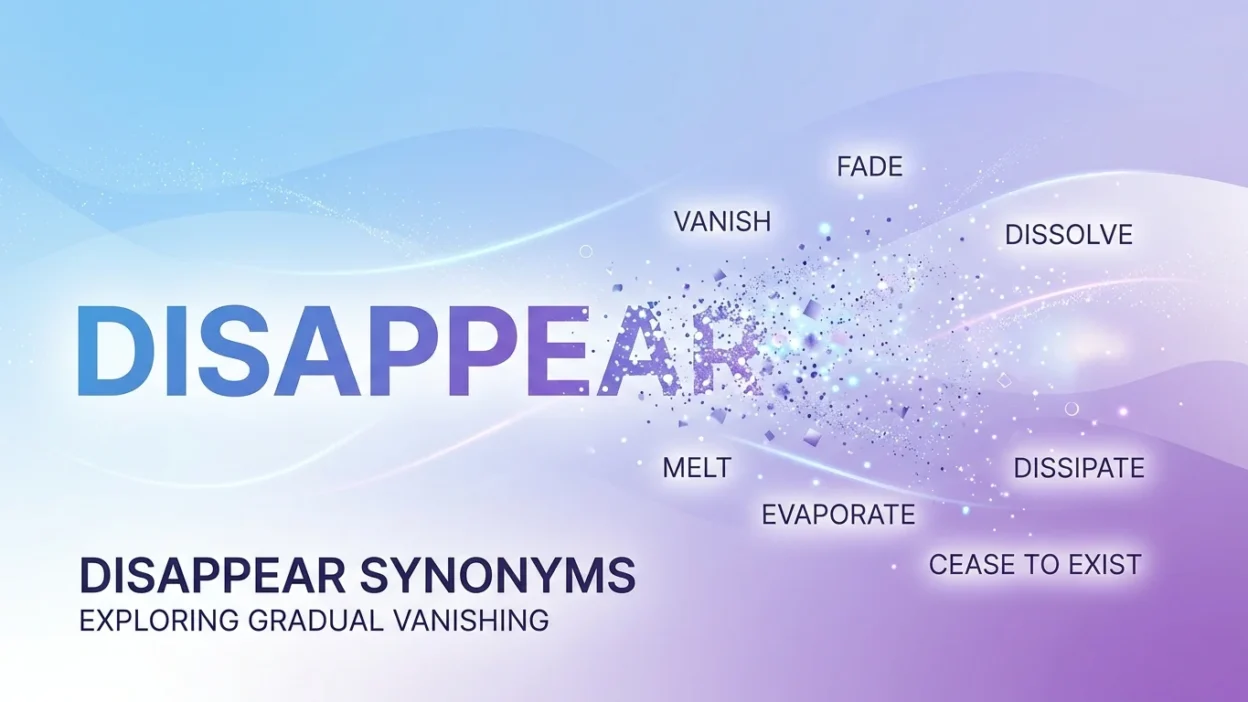
Learning disappear synonyms helps you sound more natural, expressive, and precise. It also allows you to match the tone of your sentence whether you’re describing something fading slowly, vanishing suddenly, or being removed completely.
For students, ESL learners, and writers, understanding these variations is a simple but powerful way to level up communication skills.
Meaning of “Disappear” in Simple English
The word “disappear” means to go away or stop being seen. It can refer to something physically vanishing, fading from view, or even something abstract like a feeling or sound ending.
Example:
- The sun disappeared behind the clouds.
Usage Context:
It is used in both everyday conversation and writing when something is no longer visible, present, or noticeable.
30 Synonyms of “Disappear” with Meanings and Examples
1. Vanish
Meaning: To disappear suddenly
Example Sentence: The magician made the coin vanish.
Best Usage Context: Magic, sudden actions
2. Fade
Meaning: To slowly disappear
Example Sentence: The music faded away.
Best Usage Context: Sounds, colors, emotions
3. Evaporate
Meaning: To turn into vapor or disappear quickly
Example Sentence: The water evaporated in the heat.
Best Usage Context: Liquids, figurative loss
4. Dissolve
Meaning: To break apart and disappear
Example Sentence: The sugar dissolved in tea.
Best Usage Context: Substances, groups ending
5. Melt away
Meaning: To disappear gradually
Example Sentence: His fears melted away.
Best Usage Context: Emotions, stress
6. Slip away
Meaning: To leave quietly
Example Sentence: She slipped away without saying goodbye.
Best Usage Context: Quiet exits
7. Go away
Meaning: To leave or disappear
Example Sentence: The pain went away.
Best Usage Context: Informal use
8. Die out
Meaning: To disappear completely over time
Example Sentence: The tradition died out.
Best Usage Context: Culture, habits
9. Cease
Meaning: To stop happening
Example Sentence: The noise ceased suddenly.
Best Usage Context: Formal writing
10. End
Meaning: To stop or finish
Example Sentence: The rain ended quickly.
Best Usage Context: General use
11. Withdraw
Meaning: To move back or disappear from a place
Example Sentence: The troops withdrew.
Best Usage Context: Formal, military
12. Retreat
Meaning: To go back or disappear from danger
Example Sentence: The army retreated.
Best Usage Context: War, strategy
13. Recede
Meaning: To move further away
Example Sentence: The water receded after the flood.
Best Usage Context: Natural movement
14. Sink
Meaning: To go down and disappear
Example Sentence: The ship sank into the ocean.
Best Usage Context: Water, objects
15. Drop out of sight
Meaning: To suddenly disappear from view
Example Sentence: The bird dropped out of sight.
Best Usage Context: Visual context
16. Blink out
Meaning: To disappear instantly
Example Sentence: The lights blinked out.
Best Usage Context: Sudden events
17. Phase out
Meaning: To gradually stop or disappear
Example Sentence: Old systems were phased out.
Best Usage Context: Business, technology
18. Pass away
Meaning: To die (polite form)
Example Sentence: His grandfather passed away.
Best Usage Context: Respectful tone
19. Perish
Meaning: To die or disappear
Example Sentence: Many species have perished.
Best Usage Context: Formal, serious
20. Be gone
Meaning: To no longer be present
Example Sentence: By morning, the storm was gone.
Best Usage Context: Everyday use
21. Wipe out
Meaning: To destroy completely
Example Sentence: The village was wiped out.
Best Usage Context: Disasters
22. Eliminate
Meaning: To remove completely
Example Sentence: Errors were eliminated.
Best Usage Context: Formal, technical
23. Remove
Meaning: To take away
Example Sentence: He removed the stain.
Best Usage Context: General
24. Clear
Meaning: To make something disappear
Example Sentence: The sky cleared after rain.
Best Usage Context: Weather
25. Dissipate
Meaning: To scatter and disappear
Example Sentence: The fog dissipated.
Best Usage Context: Natural elements
26. Break up
Meaning: To separate and disappear
Example Sentence: The clouds broke up.
Best Usage Context: Informal
27. Lose
Meaning: To no longer have something
Example Sentence: He lost interest.
Best Usage Context: Emotions
28. Fall away
Meaning: To gradually disappear
Example Sentence: The crowd fell away.
Best Usage Context: Groups
29. Slip from view
Meaning: To slowly disappear from sight
Example Sentence: The ship slipped from view.
Best Usage Context: Visual scenes
30. Go missing
Meaning: To disappear unexpectedly
Example Sentence: The documents went missing.
Best Usage Context: Mystery, concern
Comparison Guide: When to Use Different Synonyms
| Situation | Best Synonyms |
| Sudden disappearance | Vanish, Blink out |
| Slow disappearance | Fade, Melt away, Dissipate |
| Formal writing | Cease, Eliminate, Perish |
| Informal speech | Go away, Be gone |
| Emotional context | Melt away, Lose |
| Physical movement | Recede, Sink, Retreat |
How to Choose the Right Synonym
Choosing the right word depends on tone, speed, and context.
1. For Sudden Actions
Use: Vanish, Blink out
These show something happening instantly.
2. For Gradual Change
Use: Fade, Dissipate, Melt away
These suggest slow disappearance.
3. For Formal Writing
Use: Cease, Eliminate, Perish
These sound more professional.
4. For Casual Conversation
Use: Go away, Be gone
Simple and easy for daily use.
5. For Emotions or Abstract Ideas
Use: Melt away, Lose, Fade
Best for feelings, thoughts, or sounds.
Conclusion
Understanding and using disappear synonyms can greatly improve your English vocabulary and writing skills. Instead of repeating the same word, you can choose more precise and expressive alternatives depending on your context.
Whether something vanishes suddenly, fades slowly, or is completely removed, there is always a better word to describe it. By learning these 30 synonyms and how to use them, you’ll communicate more clearly and confidently.
Keep practicing, and soon these words will become a natural part of your everyday language.