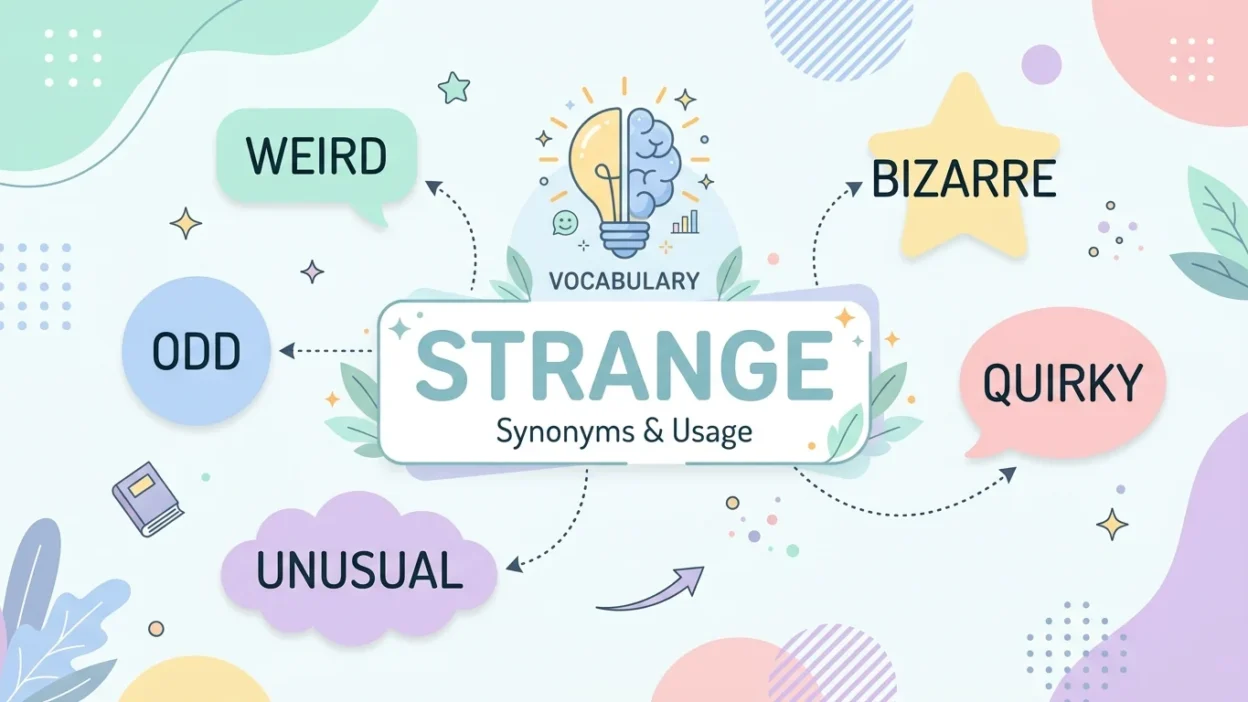
The word “strange” is common in everyday English, but relying on it too much can make your writing feel repetitive or less expressive. Whether you’re a student, ESL learner, writer, or content creator, expanding your vocabulary with strange synonyms helps you communicate more clearly and creatively.
Different situations call for different tones. Sometimes “strange” can mean unusual in a positive way, while other times it suggests something odd or even unsettling. That’s why learning the right synonyms and when to use them can make a big difference in how your message is understood.
In this guide, you’ll learn the meaning of “strange,” explore 30 useful synonyms, and understand how to choose the right word for any context.
What Does “Strange” Mean?
Strange means something that is unusual, unfamiliar, or different from what you expect.
It can describe:
- A person (someone you don’t know)
- A situation (unexpected or confusing)
- A feeling (hard to understand)
Tone: Neutral, but can be slightly negative depending on context
Example: That was a strange sound coming from the kitchen.
30 Strange Synonyms with Meanings, Examples, and Usage
1. Odd
Meaning: Not normal or expected
Example: That’s an odd way to solve the problem.
Best Usage Context: Casual conversation
2. Unusual
Meaning: Different from what is common
Example: She wore an unusual dress.
Best Usage Context: Neutral/formal
3. Weird
Meaning: Very strange or surprising
Example: That movie was really weird.
Best Usage Context: Informal
4. Peculiar
Meaning: Strange in an interesting or noticeable way
Example: He has a peculiar habit of talking to himself.
Best Usage Context: Slightly formal
5. Bizarre
Meaning: Very strange or shocking
Example: The story had a bizarre ending.
Best Usage Context: Strong expression
6. Curious
Meaning: Strange but interesting
Example: It’s curious how things worked out.
Best Usage Context: Thoughtful tone
7. Unfamiliar
Meaning: Not known before
Example: I heard an unfamiliar voice.
Best Usage Context: Neutral
8. Abnormal
Meaning: Not typical or usual
Example: The results were abnormal.
Best Usage Context: Scientific/formal
9. Eccentric
Meaning: Strange in a unique or creative way
Example: The artist was eccentric.
Best Usage Context: Positive/character description
10. Quirky
Meaning: Unusual in a fun or charming way
Example: She has a quirky sense of humor.
Best Usage Context: Positive/informal
11. Outlandish
Meaning: Very strange and hard to believe
Example: That idea sounds outlandish.
Best Usage Context: Strong opinion
12. Uncanny
Meaning: Strange in a mysterious or surprising way
Example: He has an uncanny ability to guess answers.
Best Usage Context: Slightly mysterious
13. Alien
Meaning: Very unfamiliar or different
Example: The culture felt alien to me.
Best Usage Context: Formal/descriptive
14. Foreign
Meaning: Not from your own place
Example: That custom is foreign to me.
Best Usage Context: Cultural context
15. Mysterious
Meaning: Difficult to understand or explain
Example: The disappearance remains mysterious.
Best Usage Context: Storytelling
16. Funky
Meaning: Slightly strange but stylish or cool
Example: That’s a funky outfit.
Best Usage Context: Informal/positive
17. Offbeat
Meaning: Unusual in an interesting way
Example: The film has an offbeat style.
Best Usage Context: Creative contexts
18. Rare
Meaning: Not common
Example: That’s a rare event.
Best Usage Context: Neutral
19. Unorthodox
Meaning: Not following usual rules
Example: He uses unorthodox methods.
Best Usage Context: Formal
20. Strange looking
Meaning: Appearing unusual
Example: That’s a strange looking creature.
Best Usage Context: Visual description
21. Peculiar looking
Meaning: Looks unusual
Example: The building is peculiar looking.
Best Usage Context: Mild tone
22. Extraordinary
Meaning: Very unusual and impressive
Example: She has extraordinary talent.
Best Usage Context: Positive/formal
23. Oddball
Meaning: A strange person
Example: He’s a bit of an oddball.
Best Usage Context: Informal
24. Kooky
Meaning: Silly and strange
Example: That idea sounds kooky.
Best Usage Context: Casual
25. Freaky
Meaning: Strange in a scary way
Example: That noise was freaky.
Best Usage Context: Informal/scary tone
26. Surreal
Meaning: Very strange, like a dream
Example: The experience felt surreal.
Best Usage Context: Emotional description
27. Curious looking
Meaning: Slightly strange in appearance
Example: That’s a curious looking object.
Best Usage Context: Mild curiosity
28. Abnormal looking
Meaning: Not normal in appearance
Example: The shape looked abnormal.
Best Usage Context: Formal
29. Irregular
Meaning: Not following a pattern
Example: The pattern is irregular.
Best Usage Context: Technical
30. Uncommon
Meaning: Not often seen
Example: This is an uncommon situation.
Best Usage Context: Neutral/formal
Comparison Guide: When to Use Different Strange Synonyms
| Situation | Best Synonyms |
| Casual conversation | Weird, odd, funky, kooky |
| Formal writing | Unusual, abnormal, unorthodox |
| Positive uniqueness | Quirky, eccentric, extraordinary |
| Mysterious tone | Uncanny, surreal, mysterious |
| Strong negative feeling | Bizarre, freaky, outlandish |
How to Choose the Right Synonym
Choosing the right word depends on tone, context, and intention. Here’s a simple guide:
Neutral / General Use
Use: Unusual, unfamiliar, uncommon
- Safe for most situations
- Works in both speaking and writing
Informal / Everyday Speech
Use: Weird, odd, funky, kooky
- Friendly and natural
- Avoid in formal writing
Positive or Creative Tone
Use: Quirky, eccentric, extraordinary, offbeat
- Shows uniqueness in a good way
Negative or Strong Reaction
Use: Bizarre, freaky, outlandish
- Expresses shock or disbelief
Formal or Academic Context
Use: Abnormal, unorthodox, irregular
- Best for essays, reports, or studies
Conclusion
Learning strange synonyms helps you express ideas more clearly and avoid repetition. Instead of always using “strange,” you can choose words that better match your tone—whether you want to sound casual, formal, positive, or dramatic.
The key is simple:
- Understand the meaning
- Match the tone to your situation
- Practice using different synonyms in sentences
With time, these words will become a natural part of your vocabulary, making your English more fluent, precise, and engaging.