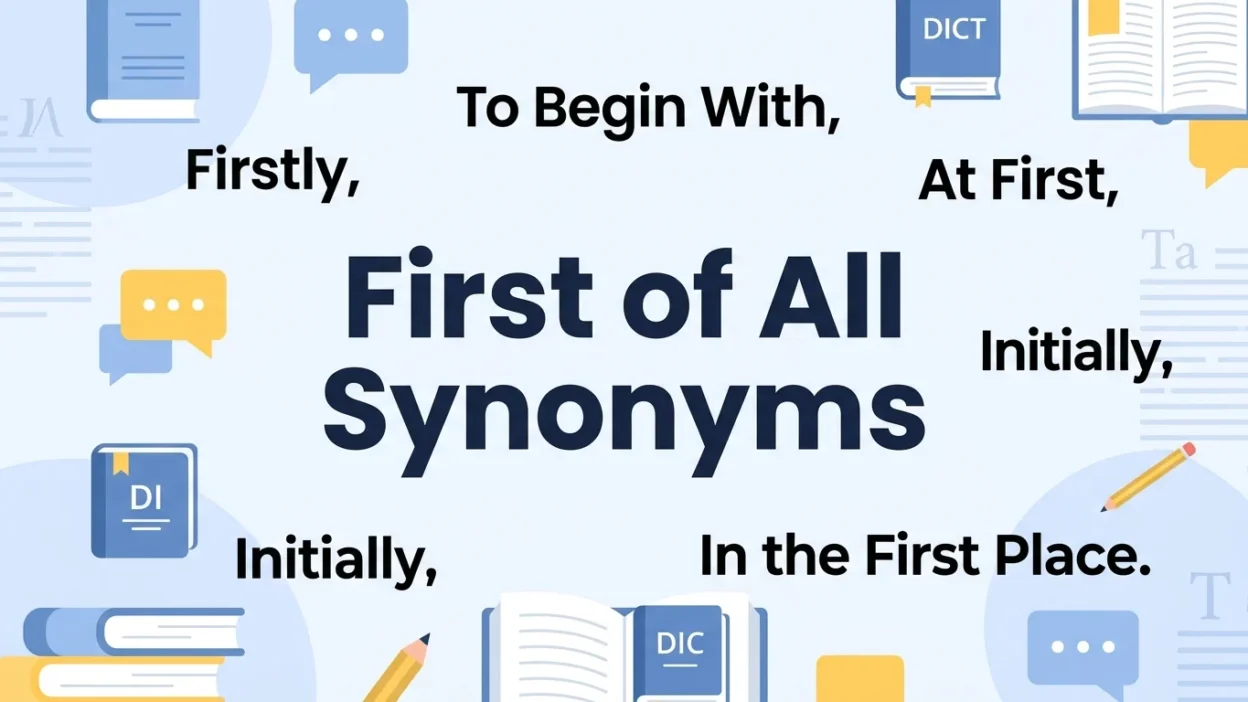
The phrase “first of all” is commonly used in English to introduce the first point in a conversation, essay, speech, or discussion. It helps organize ideas clearly and makes communication easier to understand.
However, using the same phrase repeatedly can make your writing sound repetitive. That is why many students, ESL learners, writers, and content creators search for useful first of all synonyms to improve vocabulary and writing style.
Learning alternative words and phrases can help you sound more professional, natural, and confident in both speaking and writing. In this guide, you will learn the meaning of “first of all,” discover 30 useful synonyms, and understand when to use each one correctly.
What Does “First of All” Mean?
“First of all” is a transition phrase used to introduce the first idea, point, or reason in a sequence.
It usually means:
- Before anything else
- The first point is
- To begin with
Example
First of all, we need to understand the problem before solving it.
The phrase is commonly used in:
- Academic writing
- Everyday conversations
- Blog writing
- Presentations
- Debates
- Professional communication
Why Learn First of All Synonyms?
Using different synonyms instead of repeating “first of all” can help you:
- Improve vocabulary
- Make writing more engaging
- Sound more fluent in English
- Avoid repetition
- Write better essays and articles
- Speak more naturally
These alternatives are especially useful for students, bloggers, and ESL learners who want stronger communication skills.
30 Synonyms of “First of All”
1. Firstly
Meaning: Used to introduce the first point in a formal way.
Example Sentence: Firstly, students should understand the instructions carefully.
Best Usage Context: Academic and professional writing.
2. First
Meaning: A simple word used to mention the first idea.
Example Sentence: First, let’s discuss the main topic.
Best Usage Context: Everyday speaking and writing.
3. To Begin With
Meaning: Used when starting a discussion or explanation.
Example Sentence: To begin with, the project requires better planning.
Best Usage Context: Essays, blogs, and conversations.
4. Initially
Meaning: Refers to something happening at the beginning.
Example Sentence: Initially, the team faced many challenges.
Best Usage Context: Formal and business writing.
5. At First
Meaning: Describes the starting stage of something.
Example Sentence: At first, I found the lesson difficult.
Best Usage Context: Storytelling and casual writing.
6. In the First Place
Meaning: Refers to the original reason or beginning.
Example Sentence: Why did you choose this course in the first place?
Best Usage Context: Informal discussions and arguments.
7. Before Anything Else
Meaning: Something that should happen first.
Example Sentence: Before anything else, check your equipment.
Best Usage Context: Instructions and advice.
8. Primarily
Meaning: Mainly or most importantly.
Example Sentence: The company is primarily focused on quality.
Best Usage Context: Business and formal communication.
9. Foremost
Meaning: Most important before all others.
Example Sentence: Safety is our foremost priority.
Best Usage Context: Professional and serious writing.
10. Above All
Meaning: More important than everything else.
Example Sentence: Above all, remain honest and respectful.
Best Usage Context: Motivational and persuasive writing.
11. To Start With
Meaning: Used to introduce the beginning point casually.
Example Sentence: To start with, let’s review the basics.
Best Usage Context: Informal speaking and teaching.
12. At the Outset
Meaning: At the beginning of an event or process.
Example Sentence: At the outset, the meeting was productive.
Best Usage Context: Formal reports and business writing.
13. From the Start
Meaning: From the very beginning.
Example Sentence: She supported the idea from the start.
Best Usage Context: Casual conversations and storytelling.
14. In the Beginning
Meaning: During the early stage of something.
Example Sentence: In the beginning, the process seemed confusing.
Best Usage Context: Narratives and explanations.
15. Before Everything Else
Meaning: Something considered first in importance.
Example Sentence: Before everything else, protect your health.
Best Usage Context: Advice and motivational writing.
16. Chiefly
Meaning: Mainly or especially.
Example Sentence: The article is chiefly aimed at students.
Best Usage Context: Formal and academic writing.
17. Most Importantly
Meaning: Used to highlight the key first point.
Example Sentence: Most importantly, never give up on your goals.
Best Usage Context: Speeches and persuasive content.
18. At the Beginning
Meaning: Refers to the starting point.
Example Sentence: At the beginning, everyone was nervous.
Best Usage Context: General writing and storytelling.
19. One Important Thing
Meaning: Introduces a significant point.
Example Sentence: One important thing to remember is patience.
Best Usage Context: Informal speaking and teaching.
20. The First Step
Meaning: Refers to the initial action.
Example Sentence: The first step is understanding the problem.
Best Usage Context: Tutorials and guides.
21. First and Foremost
Meaning: Most importantly at the beginning.
Example Sentence: First and foremost, thank you for your support.
Best Usage Context: Formal speeches and presentations.
22. To Open With
Meaning: Used to begin a statement or discussion.
Example Sentence: To open with, let’s examine the facts.
Best Usage Context: Presentations and formal talks.
23. Before All Else
Meaning: Before every other consideration.
Example Sentence: Before all else, focus on your education.
Best Usage Context: Advice and motivational content.
24. As a Starting Point
Meaning: Used for introducing an initial idea.
Example Sentence: As a starting point, gather all the necessary information.
Best Usage Context: Academic and professional writing.
25. In the Early Stages
Meaning: During the first phase of something.
Example Sentence: In the early stages, progress was slow.
Best Usage Context: Reports and project discussions.
26. To Kick Off
Meaning: To begin something energetically.
Example Sentence: To kick off the event, the manager gave a speech.
Best Usage Context: Informal business and events.
27. Leading Off
Meaning: Starting or introducing something first.
Example Sentence: Leading off, the teacher explained the rules.
Best Usage Context: Sports commentary and presentations.
28. In the Initial Stage
Meaning: During the beginning period.
Example Sentence: In the initial stage, mistakes are common.
Best Usage Context: Formal and technical writing.
29. First Thing
Meaning: The earliest or first action.
Example Sentence: First thing, clean your workspace.
Best Usage Context: Informal conversations.
30. The First Point Is
Meaning: Used to introduce the main first idea.
Example Sentence: The first point is understanding customer needs.
Best Usage Context: Essays, speeches, and presentations.
Comparison Guide: When to Use Different Synonyms
| Synonym | Tone | Best For |
| Firstly | Formal | Academic essays |
| First | Neutral | Everyday use |
| To Begin With | Friendly | Blogs and discussions |
| Initially | Professional | Business writing |
| At First | Casual | Stories and experiences |
| Above All | Emotional | Motivational writing |
| First and Foremost | Strong formal tone | Speeches |
| To Start With | Informal | Conversations |
| Foremost | Serious | Professional communication |
| The First Step | Practical | Tutorials and guides |
How to Choose the Right Synonym
Use Formal Synonyms for Academic Writing
Choose these words for essays, reports, and professional communication:
- Firstly
- Initially
- Primarily
- Foremost
- At the Outset
Use Casual Synonyms for Everyday Conversation
These alternatives sound more natural in speaking:
- First
- To Start With
- At First
- First Thing
- From the Start
Use Strong Emphasis Synonyms for Important Points
These phrases help highlight importance:
- Above All
- First and Foremost
- Most Importantly
- Before All Else
Use Instructional Synonyms for Guides and Tutorials
These work best in educational content:
- The First Step
- As a Starting Point
- Before Anything Else
Common Mistakes to Avoid
Using “Firstly” Too Often
Repeating “firstly” in every paragraph can sound robotic. Mix different synonyms naturally.
Choosing Very Formal Words in Casual Conversations
Words like “foremost” or “at the outset” may sound too formal in daily speaking.
Using Synonyms Without Understanding Context
Always choose a synonym that matches the tone and purpose of your sentence.
Conclusion
Learning useful first of all synonyms can improve both writing and speaking skills. Instead of repeating the same phrase, you can choose alternatives that fit different tones, situations, and communication styles.
Whether you are writing an essay, creating blog content, giving a presentation, or improving English fluency, these synonyms will help your language sound more natural and professional.
Start practicing these alternatives in daily writing and conversations to build stronger vocabulary and clearer communication skills.