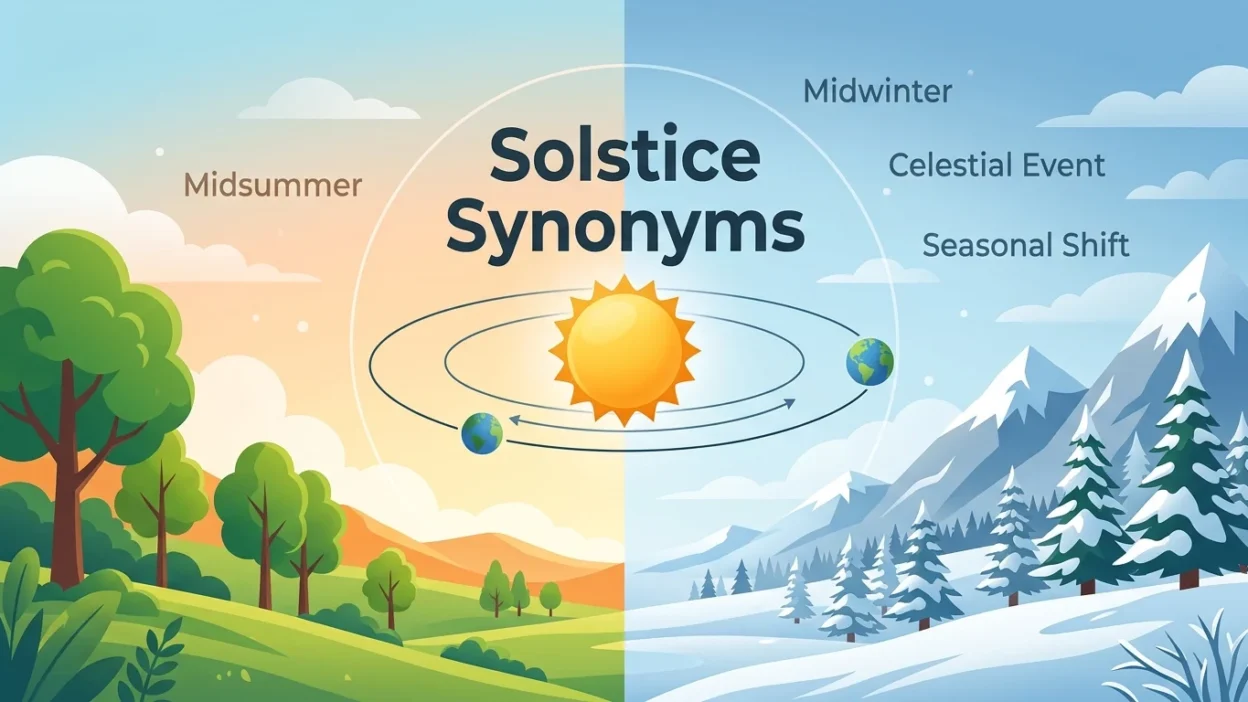
The word “solstice” is often used in astronomy, seasonal discussions, literature, and educational content. It refers to the two times of the year when the sun reaches its highest or lowest point in the sky at noon. These events mark the longest and shortest days of the year.
Learning solstice synonyms can help students, writers, and ESL learners improve vocabulary and express ideas more clearly. Some synonyms are scientific, while others are poetic or seasonal. Understanding these subtle differences makes writing more natural and engaging.
In this guide, you will learn the meaning of “solstice,” explore 30 useful synonyms and related terms, see example sentences, and discover when to use each word correctly.
Meaning of “Solstice” in Simple English
A solstice is a special day that happens twice every year:
- Summer solstice = the longest day of the year
- Winter solstice = the shortest day of the year
These events happen because of the Earth’s movement around the sun.
Tone and Usage Context
The word “solstice” is commonly used in:
- Astronomy
- Science lessons
- Seasonal writing
- Poetry and literature
- Cultural and historical discussions
It can sound:
- Scientific
- Formal
- Seasonal
- Poetic depending on the context
30 Solstice Synonyms with Meanings and Examples
1. Midyear
Meaning: The middle part of the year.
Example Sentence: Festivals are often held during midyear celebrations.
Best Usage Context: Seasonal or calendar discussions.
2. Midwinter
Meaning: The middle of the winter season.
Example Sentence: The village looked beautiful during midwinter.
Best Usage Context: Winter solstice references.
3. Midsummer
Meaning: The middle of summer.
Example Sentence: Many cultures celebrate during midsummer events.
Best Usage Context: Summer solstice themes.
4. Seasonal Turning Point
Meaning: A moment when seasons begin to change.
Example Sentence: The solstice marks a seasonal turning point.
Best Usage Context: Educational or descriptive writing.
5. Astronomical Event
Meaning: An important event related to space or the sky.
Example Sentence: The solstice is an important astronomical event.
Best Usage Context: Scientific discussions.
6. Sun Festival
Meaning: A celebration connected to the sun.
Example Sentence: Ancient group held a sun festival every winter.
Best Usage Context: Historical or cultural writing.
7. Solar Transition
Meaning: A change in the sun’s position.
Example Sentence: The solar transition signals a new season.
Best Usage Context: Scientific or formal writing.
8. Seasonal Shift
Meaning: A change from one season to another.
Example Sentence: Farmers prepare for the seasonal shift.
Best Usage Context: Nature and climate topics.
9. Longest Day
Meaning: The day with the most daylight hours.
Example Sentence: The longest day arrives during the summer solstice.
Best Usage Context: Informal explanations.
10. Shortest Day
Meaning: The day with the least daylight hours.
Example Sentence: The shortest day occurs in winter.
Best Usage Context: Winter discussions.
11. Solar Milestone
Meaning: An important moment related to the sun.
Example Sentence: The solstice is considered a solar milestone.
Best Usage Context: Formal or educational content.
12. Celestial Event
Meaning: An event happening in the sky or space.
Example Sentence: People gathered to watch the celestial event.
Best Usage Context: Astronomy topics.
13. Sun Turning Point
Meaning: The point where the sun changes direction.
Example Sentence: Ancient calendars tracked the sun turning point.
Best Usage Context: Historical explanations.
14. Equinox Counterpart
Meaning: A term comparing the solstice to an equinox.
Example Sentence: The solstice is the equinox counterpart in astronomy.
Best Usage Context: Educational comparisons.
15. Solar Celebration
Meaning: A celebration related to the sun.
Example Sentence: Communities held a solar celebration at dawn.
Best Usage Context: Cultural and festive writing.
16. Seasonal Marker
Meaning: Something that marks a seasonal change.
Example Sentence: The solstice acts as a seasonal marker.
Best Usage Context: Nature or educational writing.
17. Nature Transition
Meaning: A natural seasonal change.
Example Sentence: Animals react to the nature transition.
Best Usage Context: Environmental topics.
18. Sun Cycle Event
Meaning: An event connected to the yearly sun cycle.
Example Sentence: The ancient temple honored each sun cycle event.
Best Usage Context: Historical or scientific writing.
19. Solar Peak
Meaning: The highest point of sunlight.
Example Sentence: The solar peak arrives in June.
Best Usage Context: Summer solstice references.
20. Seasonal Milestone
Meaning: A major seasonal moment.
Example Sentence: The solstice is a seasonal milestone for many cultures.
Best Usage Context: General descriptive writing.
21. Turning of the Seasons
Meaning: The changing of seasons.
Example Sentence: Poems often describe the turning of the seasons.
Best Usage Context: Literary writing.
22. Solar Change
Meaning: A change connected to the sun’s movement.
Example Sentence: Farmers once relied on solar change patterns.
Best Usage Context: Scientific or historical content.
23. Daylight Peak
Meaning: The time with maximum daylight.
Example Sentence: The daylight peak happens during summer solstice.
Best Usage Context: Informal science writing.
24. Winter Turning Point
Meaning: The moment winter begins changing.
Example Sentence: The winter turning point brought longer days ahead.
Best Usage Context: Winter solstice explanations.
25. Summer Turning Point
Meaning: The key point during summer.
Example Sentence: The summer turning point is celebrated worldwide.
Best Usage Context: Summer festivals.
26. Ancient Solar Festival
Meaning: A traditional celebration connected to the sun.
Example Sentence: Historians studied the ancient solar festival.
Best Usage Context: Historical discussions.
27. Sun Ceremony
Meaning: A ritual honoring the sun.
Example Sentence: The group performed a sun ceremony at sunrise.
Best Usage Context: Cultural or spiritual writing.
28. Seasonal Event
Meaning: An important event connected to seasons.
Example Sentence: The solstice is a major seasonal event.
Best Usage Context: General usage.
29. Solar Occasion
Meaning: A special occasion related to the sun.
Example Sentence: Families gathered for the solar occasion.
Best Usage Context: Formal or literary writing.
30. Celestial Turning Point
Meaning: A major change in the sky’s cycle.
Example Sentence: The celestial turning point inspired ancient myths.
Best Usage Context: Poetic or scientific content.
Comparison: When to Use Different Solstice Synonyms
| Synonym | Best For | Tone |
| Midsummer | Summer discussions | Seasonal |
| Midwinter | Winter topics | Seasonal |
| Astronomical Event | Science writing | Formal |
| Celestial Event | Space topics | Scientific |
| Seasonal Shift | Nature content | Neutral |
| Turning of the Seasons | Poetry | Literary |
| Longest Day | Simple explanations | Informal |
| Shortest Day | Everyday use | Informal |
| Solar Celebration | Festivals | Cultural |
| Celestial Turning Point | Creative writing | Poetic |
How to Choose the Right Synonym
For Scientific Writing
Use:
- Astronomical Event
- Celestial Event
- Solar Transition
- Solar Change
These words sound formal and educational.
For Seasonal or Nature Writing
Use:
- Seasonal Shift
- Seasonal Marker
- Turning of the Seasons
- Nature Transition
These fit blogs, school essays, and nature articles.
For Poetry and Creative Writing
Use:
- Celestial Turning Point
- Solar Occasion
- Sun Ceremony
- Turning of the Seasons
These sound more emotional and artistic.
For Simple Everyday English
Use:
- Longest Day
- Shortest Day
- Midwinter
- Midsummer
These are easy for beginners and ESL learners.
Why Learning Solstice Synonyms Matters
Learning different words related to “solstice” helps improve communication skills. Writers can avoid repeating the same word again and again. Students can also understand science and literature more clearly.
Using varied vocabulary makes articles, essays, and creative writing more interesting. It also improves content quality because readers enjoy natural language that feels helpful and informative.
Common Mistakes When Using Solstice Synonyms
Using Scientific Terms in Casual Writing
Words like “celestial event” may sound too formal in simple conversations.
Confusing Solstice with Equinox
A solstice is different from an equinox. Solstices mark the longest or shortest days, while equinoxes have equal day and night hours.
Overusing Poetic Terms
Creative phrases work well in literature but may confuse readers in academic writing.
Conclusion
Understanding solstice synonyms can improve vocabulary, writing quality, and communication skills. Some alternatives are scientific, while others are poetic, seasonal, or cultural.
For simple everyday use, phrases like “longest day” or “midsummer” work best. For educational writing, terms like “astronomical event” and “solar transition” are more appropriate. Creative writers may prefer expressions like “celestial turning point” or “turning of the seasons.”
By choosing the right synonym for the right context, you can make your writing clearer, more engaging, and more professional.