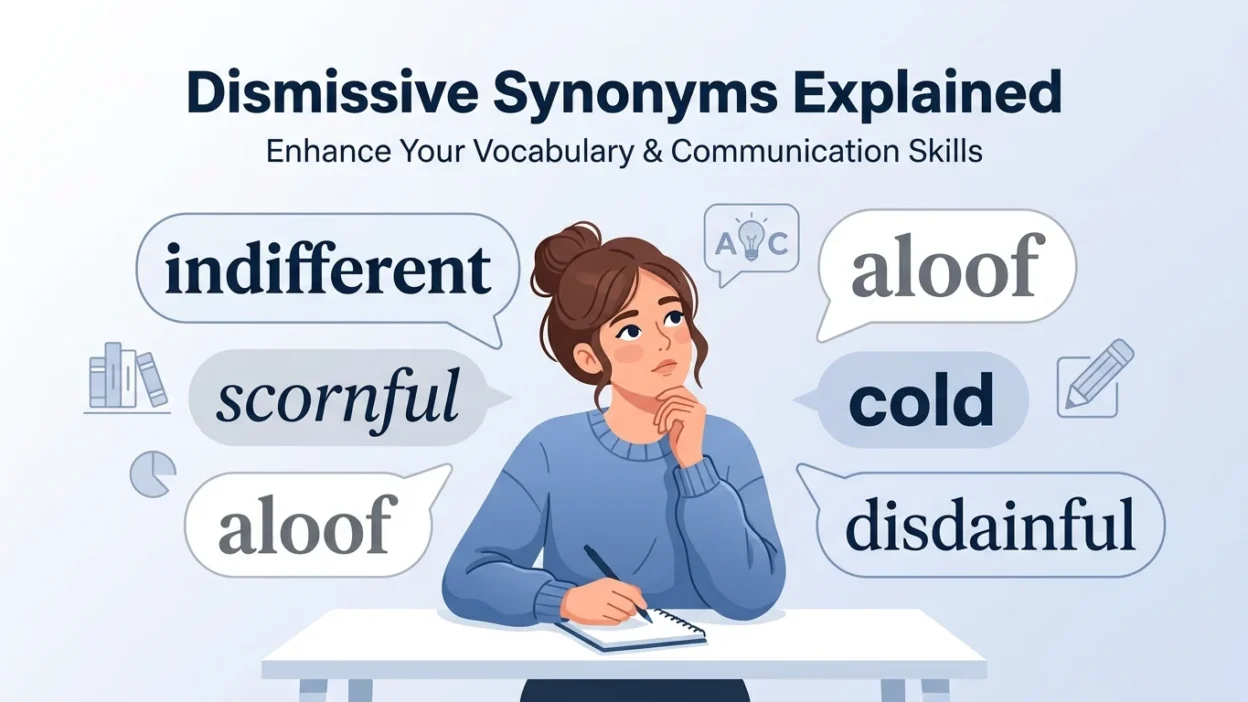
Language shapes how we express feelings, attitudes, and reactions. One common tone people want to describe is being dismissive when someone ignores, downplays, or shows a lack of respect for something. Whether you’re writing an essay, improving your English, or creating content, knowing different ways to say “dismissive” can make your communication more precise and impactful.
Using the right synonym helps you match tone and context. For example, some words sound rude or harsh, while others feel more neutral or formal. This guide will help you understand the meaning of “dismissive” and explore 30 useful synonyms with simple explanations, examples, and usage tips.
Meaning of “Dismissive” (Simple Explanation)
“Dismissive” describes a behavior where someone shows that they do not care about something or think it is unimportant.
Tone: Often negative
Usage Context: Used when someone ignores ideas, feelings, or opinions without giving them proper attention.
Example:
She gave a dismissive response and didn’t listen to my suggestion.
30 Dismissive Synonyms (With Meanings, Examples, and Usage)
1. Ignoring
Meaning: Not paying attention
Example Sentence: He kept ignoring her questions.
Best Usage Context: Casual or everyday situations
2. Indifferent
Meaning: Not caring at all
Example Sentence: She seemed indifferent to the news.
Best Usage Context: Neutral or formal writing
3. Uninterested
Meaning: Lacking interest
Example Sentence: He looked uninterested during the meeting.
Best Usage Context: Professional or academic tone
4. Disregarding
Meaning: Not considering something
Example Sentence: They kept disregarding the rules.
Best Usage Context: Formal or rule based contexts
5. Neglectful
Meaning: Not giving proper care or attention
Example Sentence: His neglectful attitude caused problems.
Best Usage Context: Serious or emotional topics
6. Contemptuous
Meaning: Showing strong disrespect
Example Sentence: She gave him a contemptuous look.
Best Usage Context: Strong negative tone
7. Scornful
Meaning: Showing dislike or disrespect
Example Sentence: He made a scornful remark.
Best Usage Context: Emotional or literary writing
8. Disdainful
Meaning: Showing that something is not worthy
Example Sentence: She was disdainful of his ideas.
Best Usage Context: Formal or expressive writing
9. Aloof
Meaning: Distant and not friendly
Example Sentence: He remained aloof in conversations.
Best Usage Context: Personality descriptions
10. Cold
Meaning: Emotionally distant
Example Sentence: Her cold reply hurt his feelings.
Best Usage Context: Emotional or personal writing
11. Unresponsive
Meaning: Not reacting
Example Sentence: He was unresponsive to feedback.
Best Usage Context: Professional or technical contexts
12. Detached
Meaning: Emotionally removed
Example Sentence: She sounded detached on the call.
Best Usage Context: Neutral or analytical tone
13. Careless
Meaning: Not careful or thoughtful
Example Sentence: His careless attitude caused mistakes.
Best Usage Context: Informal or general writing
14. Casual
Meaning: Not serious or concerned
Example Sentence: He gave a casual response.
Best Usage Context: Light, everyday tone
15. Flippant
Meaning: Not taking something seriously
Example Sentence: Her flippant comment offended others.
Best Usage Context: Informal but critical tone
16. Rude
Meaning: Not polite
Example Sentence: His rude behavior upset everyone.
Best Usage Context: Everyday language
17. Insensitive
Meaning: Not caring about others’ feelings
Example Sentence: That was an insensitive remark.
Best Usage Context: Emotional or social topics
18. Brusque
Meaning: Short and unfriendly
Example Sentence: He gave a brusque reply.
Best Usage Context: Formal or descriptive writing
19. Curt
Meaning: Very short and slightly rude
Example Sentence: She answered in a curt tone.
Best Usage Context: Professional or literary tone
20. Offhand
Meaning: Said without thinking
Example Sentence: He made an offhand comment.
Best Usage Context: Casual conversation
21. Apathetic
Meaning: Showing no emotion or interest
Example Sentence: The team seemed apathetic.
Best Usage Context: Formal or psychological context
22. Unconcerned
Meaning: Not worried or interested
Example Sentence: She seemed unconcerned about the issue.
Best Usage Context: Neutral tone
23. Rejecting
Meaning: Not accepting something
Example Sentence: He was rejecting all suggestions.
Best Usage Context: Decision making contexts
24. Belittling
Meaning: Making something seem unimportant
Example Sentence: She kept belittling his efforts.
Best Usage Context: Negative interpersonal tone
25. Mocking
Meaning: Making fun of something
Example Sentence: His mocking tone was obvious.
Best Usage Context: Informal or emotional writing
26. Derisive
Meaning: Showing ridicule
Example Sentence: They gave a derisive laugh.
Best Usage Context: Formal or literary tone
27. Minimizing
Meaning: Making something seem smaller
Example Sentence: He kept minimizing the problem.
Best Usage Context: Analytical or discussion context
28. Dismissive sounding
Meaning: Appearing uninterested
Example Sentence: Her voice sounded dismissive.
Best Usage Context: Describing tone
29. Nonchalant
Meaning: Calm and unconcerned
Example Sentence: He acted nonchalant about the issue.
Best Usage Context: Casual or descriptive tone
30. Snobbish
Meaning: Acting superior
Example Sentence: Her snobbish attitude was clear.
Best Usage Context: Social or personality description
Comparison Guide: When to Use Different Dismissive Synonyms
| Tone/Intent | Best Words to Use | Example Situation |
| Neutral | Indifferent, Uninterested, Detached | Academic writing |
| Slightly Negative | Unresponsive, Casual, Offhand | Workplace tone |
| Strong Negative | Contemptuous, Scornful, Disdainful | Arguments |
| Emotional | Insensitive, Cold, Belittling | Personal issues |
| Informal | Rude, Mocking, Nonchalant | Everyday speech |
How to Choose the Right Synonym
Choosing the right synonym depends on tone, situation, and intent.
For formal writing
Use: Indifferent, Detached, Disregarding
These sound professional and clear.
For emotional situations
Use: Cold, Insensitive, Belittling
These show feelings and impact.
For strong criticism
Use: Contemptuous, Scornful, Derisive
These express deep disrespect.
For casual conversation
Use: Rude, Nonchalant, Offhand
These are simple and natural.
For personality description
Use: Aloof, Snobbish, Apathetic
These describe long term behavior.
Conclusion
Understanding “dismissive synonyms” helps you express ideas more clearly and accurately. Instead of repeating the same word, you can choose a synonym that fits the exact tone whether neutral, emotional, or critical.
The key is to think about how strong your message should be and where you are using it. With practice, these synonyms will improve your writing, speaking, and overall communication.
If you keep these examples and contexts in mind, you’ll always find the right word to express a dismissive attitude effectively.