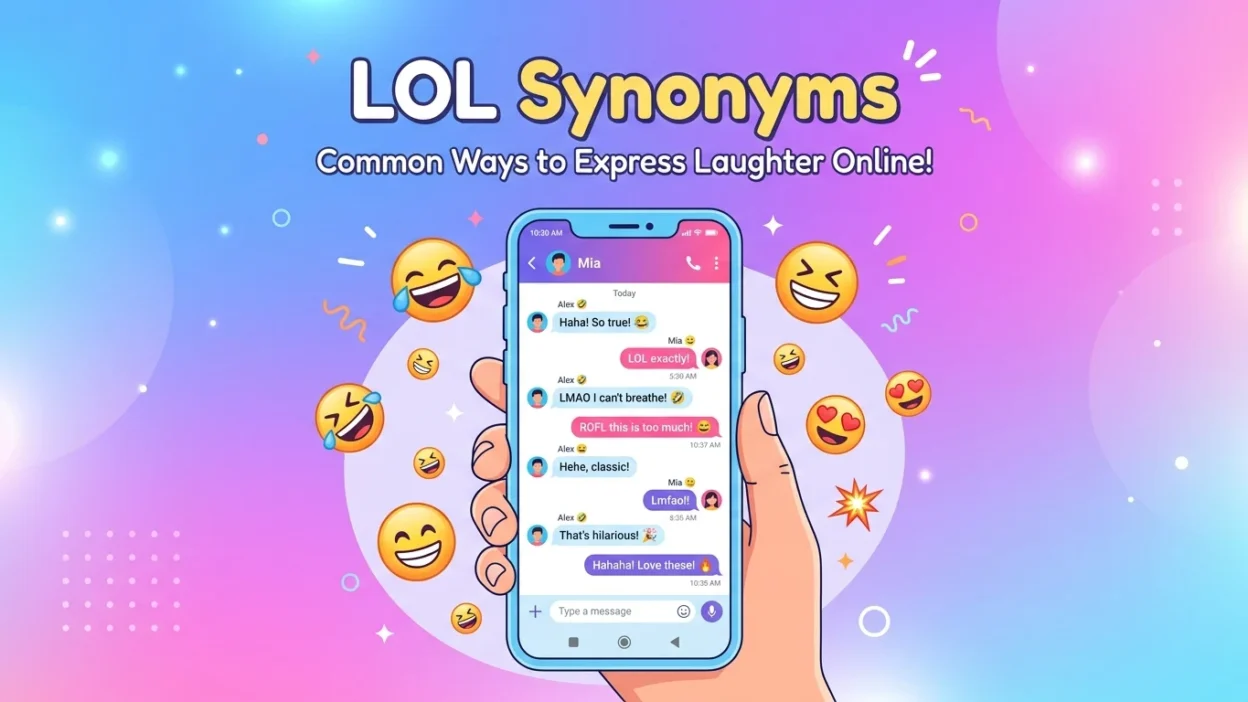
In today’s digital world, “LOL” is one of the most commonly used expressions. You see it in chats, social media posts, and even casual emails. But relying on the same word again and again can make your writing feel repetitive and less expressive.
That’s where learning LOL synonyms becomes useful. Whether you’re a student, ESL learner, writer, or content creator, having a variety of alternatives helps you communicate tone, emotion, and personality more effectively.
In this guide, you’ll learn what “LOL” really means, explore 30 useful synonyms, and understand exactly when and how to use them naturally.
What Does “LOL” Mean?
“LOL” stands for “Laughing Out Loud.”
It is used to show that something is funny or amusing. However, in modern usage, it doesn’t always mean actual loud laughter. Sometimes it simply shows mild amusement or friendliness in conversation.
Tone: Casual, informal
Usage Context: Text messages, social media, chats, informal writing
30 LOL Synonyms with Meanings, Examples, and Usage
1. Haha
Meaning: A simple way to show laughter
Example Sentence: That joke was funny, haha!
Best Usage Context: Casual chats and texts
2. LMAO
Meaning: Laughing very hard
Example Sentence: That meme made me LMAO!
Best Usage Context: Informal, strong humor
3. ROFL
Meaning: Laughing uncontrollably
Example Sentence: I was ROFL after watching that video.
Best Usage Context: Online humor, memes
4. Haha nice
Meaning: Light amusement or approval
Example Sentence: Haha nice, you did it!
Best Usage Context: Friendly conversations
5. Giggle
Meaning: Soft, light laughter
Example Sentence: She began to giggle at the joke.
Best Usage Context: Gentle humor
6. Chuckle
Meaning: Quiet, controlled laughter
Example Sentence: He chuckled at the comment.
Best Usage Context: Writing and storytelling
7. Snicker
Meaning: Slightly secret or rude laugh
Example Sentence: They snickered at his mistake.
Best Usage Context: Informal or negative tone
8. Teehee
Meaning: Cute or playful laugh
Example Sentence: Teehee, that was funny!
Best Usage Context: Playful or childish tone
9. Hehe
Meaning: Soft, slightly mischievous laugh
Example Sentence: Hehe, I knew it!
Best Usage Context: Casual, teasing tone
10. LMFAO
Meaning: Extremely strong laughter
Example Sentence: That clip had me LMFAO.
Best Usage Context: Very informal humor
11. Cracking up
Meaning: Laughing a lot
Example Sentence: I was cracking up during the show.
Best Usage Context: Spoken English
12. Burst out laughing
Meaning: Suddenly start laughing
Example Sentence: She burst out laughing unexpectedly.
Best Usage Context: Descriptive writing
13. In stitches
Meaning: Laughing very hard
Example Sentence: That joke had me in stitches.
Best Usage Context: Informal speech
14. Rolling with laughter
Meaning: Laughing uncontrollably
Example Sentence: We were rolling with laughter.
Best Usage Context: Storytelling
15. Dying laughing
Meaning: Extremely amused
Example Sentence: I’m dying laughing at this!
Best Usage Context: Casual digital talk
16. That’s hilarious
Meaning: Very funny
Example Sentence: That’s hilarious, I love it!
Best Usage Context: Semi formal conversations
17. So funny
Meaning: Clearly amusing
Example Sentence: That story is so funny.
Best Usage Context: General use
18. Funny 😂
Meaning: Funny with emotion
Example Sentence: That’s funny 😂
Best Usage Context: Social media
19. Laughing hard
Meaning: Strong laughter
Example Sentence: I’m laughing hard right now.
Best Usage Context: Informal tone
20. Can’t stop laughing
Meaning: Continuous laughter
Example Sentence: I can’t stop laughing at this.
Best Usage Context: Casual chats
21. Good one
Meaning: Appreciating a joke
Example Sentence: Good one, that was clever!
Best Usage Context: Friendly tone
22. That made my day
Meaning: Something very amusing
Example Sentence: That joke made my day.
Best Usage Context: Positive conversations
23. Classic
Meaning: Funny in a familiar way
Example Sentence: That’s classic, haha.
Best Usage Context: Informal speech
24. Hilarious stuff
Meaning: Very funny content
Example Sentence: This is hilarious stuff!
Best Usage Context: Casual writing
25. I’m amused
Meaning: Light enjoyment
Example Sentence: I’m amused by that.
Best Usage Context: Slightly formal tone
26. That’s amusing
Meaning: Mildly funny
Example Sentence: That’s amusing, actually.
Best Usage Context: Polite conversation
27. LOL wow
Meaning: Surprise + humor
Example Sentence: LOL wow, that was unexpected!
Best Usage Context: Online chats
28. Haha good one
Meaning: Appreciation of humor
Example Sentence: Haha good one, I liked it.
Best Usage Context: Friendly texting
29. I laughed so much
Meaning: Strong laughter
Example Sentence: I laughed so much at that scene.
Best Usage Context: Storytelling
30. That cracked me up
Meaning: Made you laugh hard
Example Sentence: That cracked me up!
Best Usage Context: Informal speech
Comparison Guide: When to Use Different LOL Synonyms
| Situation | Best Synonyms |
| Casual texting | haha, hehe, LOL, good one |
| Strong laughter | LMAO, ROFL, dying laughing |
| Polite or semi formal | that’s amusing, I’m amused |
| Writing stories | chuckle, giggle, burst out laughing |
| Social media | funny 😂, cracking up |
How to Choose the Right Synonym
Choosing the right LOL synonym depends on your tone and situation.
For casual chats:
Use simple words like haha, hehe, good one
For strong reactions:
Choose LMAO, ROFL, dying laughing
For writing and storytelling:
Use descriptive words like chuckle, giggle, burst out laughing
For polite or formal tone:
Go with that’s amusing, I’m amused
For social media expression:
Use emojis or phrases like funny 😂, cracking up
Conclusion
Using only “LOL” can limit your expression. By learning and using different LOL synonyms, you can make your communication more natural, engaging, and expressive.
From simple options like haha to stronger expressions like LMAO, each synonym adds a different shade of meaning. The key is to match your word with the tone, situation, and audience.
Start practicing these alternatives in your daily conversations and writing you’ll sound more fluent, confident, and creative in no time.