
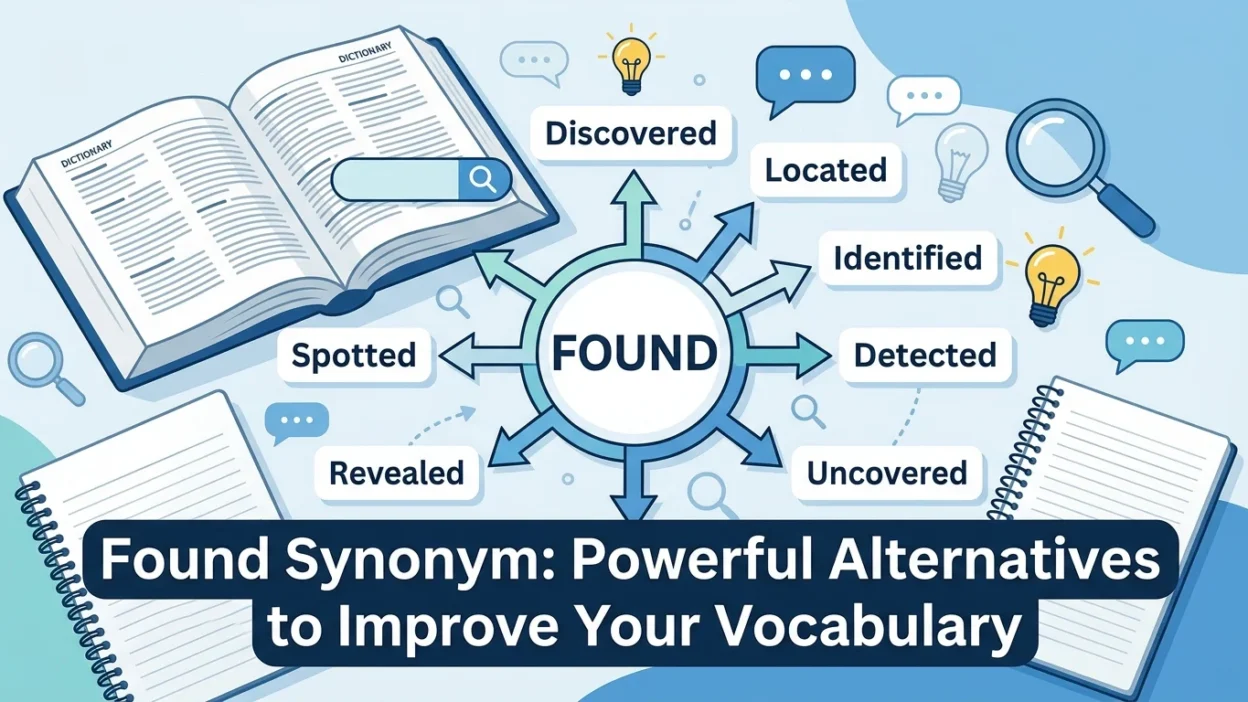
Have you ever used the word “found” repeatedly in your writing and wanted a better alternative? Learning a suitable found synonym can make your sentences more interesting, professional, and precise. Whether you are a student, ESL learner, writer, or content creator, expanding your vocabulary helps you communicate more effectively.
The word found is commonly used in everyday English. It can mean discovering something, locating an object, identifying information, or reaching a conclusion. Because it has multiple meanings, different synonyms may work better depending on the context.
In this guide, you’ll learn the meaning of found, explore 30 useful synonyms, understand when to use each one, and discover how to choose the right alternative for your writing.
Meaning of “Found”
The word found is the past tense of find.
Simple Meaning: To discover, locate, identify, or come across something.
Example:
I found my keys under the sofa.
Usage Context:
The word is used when someone discovers an object, information, solution, person, or fact that was previously unknown or missing.
30 Synonyms of Found
1. Discovered
Word: Discovered
Meaning: Found something for the first time.
Example Sentence: She discovered an old photograph in the attic.
Best Usage Context: New findings, exploration, research.
2. Located
Word: Located
Meaning: Found the exact position of something.
Example Sentence: The rescue team located the missing hikers.
Best Usage Context: Places, objects, people.
3. Identified
Word: Identified
Meaning: Recognized or determined what something is.
Example Sentence: Scientists identified a new species of insect.
Best Usage Context: Research, investigations.
4. Detected
Word: Detected
Meaning: Noticed or discovered something difficult to see.
Example Sentence: The sensor detected smoke in the building.
Best Usage Context: Technology, science, security.
5. Uncovered
Word: Uncovered
Meaning: Revealed something hidden.
Example Sentence: Reporters uncovered important evidence.
Best Usage Context: Investigations, journalism.
6. Revealed
Word: Revealed
Meaning: Made something known.
Example Sentence: The study revealed surprising results.
Best Usage Context: Reports, findings.
7. Noticed
Word: Noticed
Meaning: Became aware of something.
Example Sentence: I noticed a mistake in the document.
Best Usage Context: Everyday observations.
8. Observed
Word: Observed
Meaning: Saw or watched carefully.
Example Sentence: Researchers observed unusual behavior.
Best Usage Context: Scientific studies.
9. Encountered
Word: Encountered
Meaning: Met or came across unexpectedly.
Example Sentence: We encountered several challenges.
Best Usage Context: Experiences and situations.
10. Spotted
Word: Spotted
Meaning: Saw something quickly.
Example Sentence: She spotted her friend in the crowd.
Best Usage Context: Informal conversation.
11. Traced
Word: Traced
Meaning: Found by following clues.
Example Sentence: Police traced the source of the call.
Best Usage Context: Investigations.
12. Retrieved
Word: Retrieved
Meaning: Found and brought back.
Example Sentence: He retrieved the lost files.
Best Usage Context: Data, objects.
13. Recovered
Word: Recovered
Meaning: Found something that was lost.
Example Sentence: The wallet was recovered yesterday.
Best Usage Context: Lost items.
14. Secured
Word: Secured
Meaning: Successfully obtained something.
Example Sentence: She secured a scholarship.
Best Usage Context: Opportunities and achievements.
15. Gained
Word: Gained
Meaning: Obtained or acquired.
Example Sentence: He gained valuable experience.
Best Usage Context: Skills, knowledge.
16. Obtained
Word: Obtained
Meaning: Got something successfully.
Example Sentence: They obtained permission to proceed.
Best Usage Context: Formal writing.
17. Acquired
Word: Acquired
Meaning: Gained possession of something.
Example Sentence: She acquired a new skill.
Best Usage Context: Business and learning.
18. Learned
Word: Learned
Meaning: Found out information.
Example Sentence: I learned about the event yesterday.
Best Usage Context: Information and education.
19. Determined
Word: Determined
Meaning: Found out after research or study.
Example Sentence: Experts determined the cause of the issue.
Best Usage Context: Research and analysis.
20. Established
Word: Established
Meaning: Proved or found something to be true.
Example Sentence: The investigation established the facts.
Best Usage Context: Formal reports.
21. Verified
Word: Verified
Meaning: Confirmed accuracy.
Example Sentence: The information was verified.
Best Usage Context: Fact checking.
22. Confirmed
Word: Confirmed
Meaning: Proved correct.
Example Sentence: Tests confirmed the diagnosis.
Best Usage Context: Medical and professional settings.
23. Recognized
Word: Recognized
Meaning: Identified from previous knowledge.
Example Sentence: I recognized his voice immediately.
Best Usage Context: People and familiar things.
24. Pinpointed
Word: Pinpointed
Meaning: Found exactly.
Example Sentence: Engineers pinpointed the problem.
Best Usage Context: Technical situations.
25. Came Across
Word: Came Across
Meaning: Found by chance.
Example Sentence: I came across an interesting article.
Best Usage Context: Casual writing.
26. Ran Into
Word: Ran Into
Meaning: Found unexpectedly.
Example Sentence: I ran into an old classmate.
Best Usage Context: Informal conversation.
27. Hit Upon
Word: Hit Upon
Meaning: Found an idea unexpectedly.
Example Sentence: She hit upon a creative solution.
Best Usage Context: Ideas and innovation.
28. Unearthed
Word: Unearthed
Meaning: Discovered something hidden.
Example Sentence: Archaeologists unearthed ancient artifacts.
Best Usage Context: History and discoveries.
29. Exposed
Word: Exposed
Meaning: Revealed something concealed.
Example Sentence: The audit exposed several errors.
Best Usage Context: Investigations.
30. Ascertained
Word: Ascertained
Meaning: Found out with certainty.
Example Sentence: The exact cause was ascertained later.
Best Usage Context: Formal and academic writing.
Comparison : When to Use Different Synonyms
| Synonym | Best For | Tone |
| Discovered | New findings | Neutral |
| Located | Finding a place or object | Professional |
| Identified | Recognition | Formal |
| Detected | Technology and science | Technical |
| Uncovered | Hidden information | Investigative |
| Spotted | Quick visual finding | Casual |
| Retrieved | Recovering items | Professional |
| Determined | Research conclusions | Academic |
| Confirmed | Verifying facts | Formal |
| Came Across | Chance discoveries | Informal |
How to Choose the Right Synonym
For Scientific or Academic Writing
Use:
- Determined
- Identified
- Detected
- Established
- Ascertained
These words sound professional and precise.
For Everyday Conversation
Use:
- Found
- Noticed
- Spotted
- Came Across
- Ran Into
These are easy and natural in daily speech.
For Investigations and Research
Use:
- Uncovered
- Revealed
- Traced
- Exposed
- Verified
These words emphasize discovering important information.
For Recovering Lost Things
Use:
- Retrieved
- Recovered
- Located
These work well when something was missing.
For Unexpected Discoveries
Use:
- Encountered
- Came Across
- Hit Upon
- Unearthed
These suggest finding something by chance.
Why Learning Found Synonyms Matters
Using different synonyms instead of repeating found can:
- Improve writing quality
- Increase vocabulary knowledge
- Make essays more engaging
- Help ESL learners sound more natural
- Create stronger and more precise sentences
Choosing the correct synonym also helps readers better understand exactly how something was found.
Conclusion
Understanding the meaning of found and learning the right found synonym can greatly improve your English vocabulary and writing skills. While found is a useful everyday word, alternatives such as discovered, located, identified, uncovered, and determined often provide greater accuracy and variety.
The best synonym depends on your purpose, tone, and context. By practicing these 30 alternatives, you’ll be able to write more naturally, avoid repetition, and communicate your ideas more effectively in both academic and everyday situations.