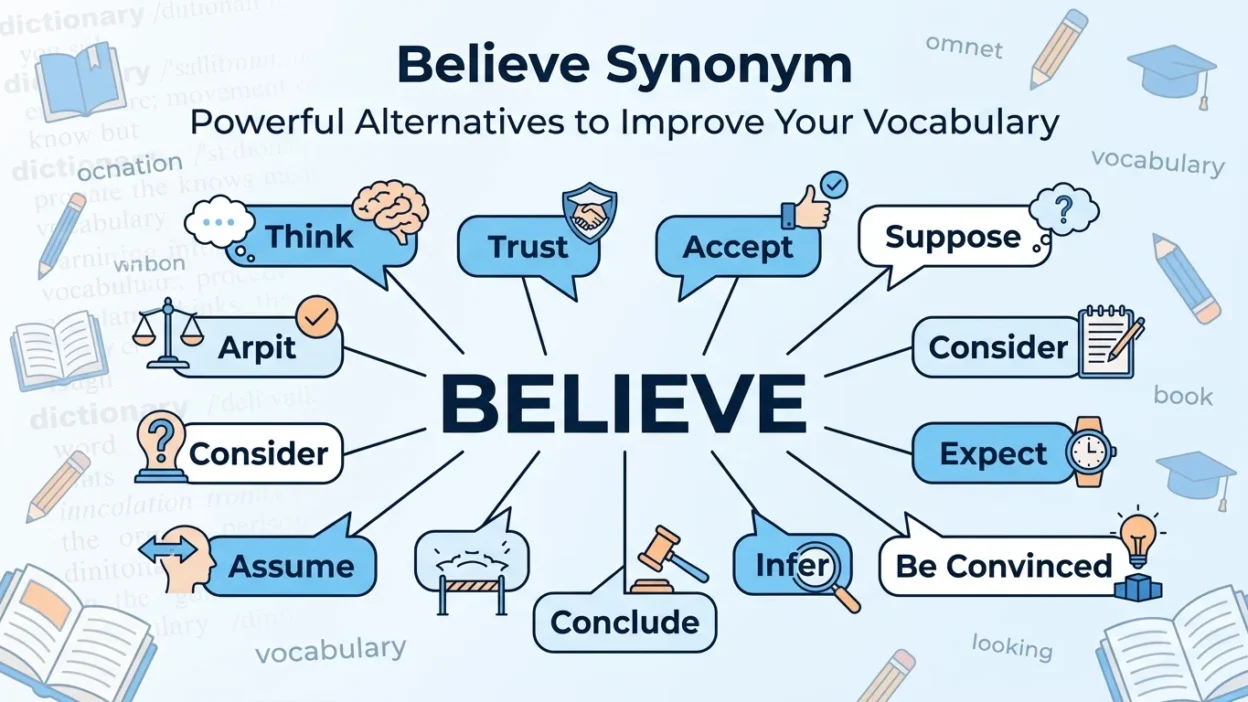
Understanding a believe synonym can help you communicate more clearly and effectively in both writing and speaking. Whether you are a student, ESL learner, writer, or content creator, knowing different ways to say “believe” allows you to express varying levels of certainty, trust, and opinion.
The word believe is commonly used in everyday conversations, academic writing, and professional communication. However, using the same word repeatedly can make your content sound repetitive. Learning synonyms helps improve vocabulary, enhance writing quality, and make communication more engaging.
In this guide, you’ll discover the meaning of “believe,” explore 30 useful synonyms, learn when to use each one, and find practical examples to strengthen your understanding.
Meaning of “Believe”
The word believe means to accept something as true, real, or trustworthy. It can also mean having confidence in someone or something.
Simple Definition
To think that something is true or likely to be true.
Usage Context
- Everyday conversations
- Academic discussions
- Professional communication
- Expressing opinions
- Showing trust or confidence
30 Synonyms of Believe
1. Think
Meaning: To have an opinion or idea about something.
Example Sentence: I think the meeting starts at 10 a.m.
Best Usage Context: Casual conversations and personal opinions.
2. Trust
Meaning: To have confidence in someone or something.
Example Sentence: I trust my best friend completely.
Best Usage Context: Relationships and reliability.
3. Accept
Meaning: To recognize something as true.
Example Sentence: She accepted the explanation without question.
Best Usage Context: Facts and information.
4. Assume
Meaning: To suppose something without full proof.
Example Sentence: Don’t assume everyone agrees with you.
Best Usage Context: Predictions and guesses.
5. Suppose
Meaning: To think something is probably true.
Example Sentence: I suppose he will arrive soon.
Best Usage Context: Informal assumptions.
6. Consider
Meaning: To think carefully about something.
Example Sentence: Many people consider exercise important.
Best Usage Context: Thoughtful opinions.
7. Imagine
Meaning: To form an idea in your mind.
Example Sentence: I can imagine how difficult that was.
Best Usage Context: Creative thinking.
8. Expect
Meaning: To think something will happen.
Example Sentence: We expect good results this year.
Best Usage Context: Predictions and future events.
9. Presume
Meaning: To believe something based on probability.
Example Sentence: I presume they have already left.
Best Usage Context: Formal assumptions.
10. Conclude
Meaning: To decide after considering evidence.
Example Sentence: Scientists concluded the study was successful.
Best Usage Context: Research and analysis.
11. Reckon
Meaning: To think or believe.
Example Sentence: I reckon it’s a great idea.
Best Usage Context: Informal speech.
12. Be Convinced
Meaning: To be certain something is true.
Example Sentence: She is convinced he is honest.
Best Usage Context: Strong beliefs.
13. Have Faith In
Meaning: To trust deeply.
Example Sentence: I have faith in your abilities.
Best Usage Context: Encouragement and trust.
14. Credit
Meaning: To accept something as true.
Example Sentence: Few people credited the rumor.
Best Usage Context: Information and claims.
15. Endorse
Meaning: To publicly support or approve.
Example Sentence: Experts endorse this method.
Best Usage Context: Professional recommendations.
16. Maintain
Meaning: To continue believing strongly.
Example Sentence: He maintains that he is innocent.
Best Usage Context: Arguments and debates.
17. Hold
Meaning: To keep an opinion.
Example Sentence: Many people hold different views.
Best Usage Context: Formal opinions.
18. Suspect
Meaning: To think something may be true.
Example Sentence: I suspect they know the answer.
Best Usage Context: Uncertain beliefs.
19. Infer
Meaning: To reach a conclusion from evidence.
Example Sentence: We can infer the cause from the data.
Best Usage Context: Analysis and reasoning.
20. Gather
Meaning: To understand from available information.
Example Sentence: I gather that the event was successful.
Best Usage Context: Observations.
21. Feel
Meaning: To personally think or believe.
Example Sentence: I feel this decision is correct.
Best Usage Context: Personal opinions.
22. Judge
Meaning: To form an opinion after evaluation.
Example Sentence: I judge the proposal to be practical.
Best Usage Context: Formal assessments.
23. Estimate
Meaning: To roughly believe or calculate.
Example Sentence: Experts estimate the project will cost more.
Best Usage Context: Numbers and predictions.
24. Be Certain
Meaning: To have no doubt.
Example Sentence: She is certain the answer is correct.
Best Usage Context: Strong confidence.
25. Be Sure
Meaning: To feel confident about something.
Example Sentence: I’m sure he will help us.
Best Usage Context: Everyday confidence.
26. Trust In
Meaning: To rely on someone or something.
Example Sentence: We trust in their experience.
Best Usage Context: Confidence and reliability.
27. Depend On
Meaning: To rely on something as dependable.
Example Sentence: Many people depend on technology daily.
Best Usage Context: Reliability and support.
28. Rely On
Meaning: To trust for help or support.
Example Sentence: You can rely on me anytime.
Best Usage Context: Trustworthy relationships.
29. Acknowledge
Meaning: To recognize something as true.
Example Sentence: She acknowledged the facts.
Best Usage Context: Formal acceptance.
30. Conviction
Meaning: A firmly held belief.
Example Sentence: He spoke with conviction about the issue.
Best Usage Context: Strong personal beliefs.
Comparison Table: When to Use Different Believe Synonyms
| Synonym | Strength of Belief | Best Situation |
| Think | Moderate | Everyday opinions |
| Trust | Strong | Relationships |
| Accept | Moderate | Facts and information |
| Assume | Weak | Guesses |
| Suppose | Weak | Informal opinions |
| Consider | Moderate | Thoughtful discussions |
| Expect | Strong | Future events |
| Presume | Moderate | Formal assumptions |
| Conclude | Strong | Evidence based decisions |
| Be Convinced | Very Strong | Certainty |
| Have Faith In | Very Strong | Deep trust |
| Suspect | Weak | Uncertainty |
| Infer | Strong | Logical reasoning |
| Be Sure | Strong | Confidence |
| Rely On | Strong | Dependability |
How to Choose the Right Synonym
Choosing the right believe synonym depends on your purpose and tone.
For Casual Conversations
Use:
- Think
- Feel
- Suppose
- Reckon
These sound natural and friendly.
For Formal Writing
Use:
- Consider
- Presume
- Conclude
- Infer
- Acknowledge
These sound professional and academic.
For Strong Confidence
Use:
- Trust
- Be Convinced
- Be Certain
- Have Faith In
These show a high level of certainty.
For Uncertain Situations
Use:
- Assume
- Suspect
- Suppose
These indicate that complete proof may not exist.
For Logical Analysis
Use:
- Infer
- Conclude
- Judge
These work best when evidence supports a belief.
Common Mistakes When Using Believe Synonyms
Using “Assume” Instead of “Know”
Assume suggests uncertainty, while know indicates certainty.
Confusing “Trust” and “Believe”
Trust involves confidence in a person or system, while believe can refer to ideas or facts.
Using Formal Synonyms in Casual Conversation
Words like “presume” and “infer” may sound too formal in everyday speech.
Benefits of Learning Believe Synonyms
- Improves writing quality
- Expands vocabulary
- Reduces repetition
- Helps express precise meanings
- Enhances communication skills
- Makes content more engaging
Conclusion
Learning a believe synonym is a simple yet powerful way to improve your vocabulary and communication skills. While “believe” remains a useful everyday word, alternatives such as think, trust, consider, conclude, infer, and be convinced help you express different levels of certainty and trust.