The term undead synonym is useful for students, ESL learners, writers, gamers, and content creators who want to describe creatures that are neither fully alive nor completely dead. Whether you are writing fantasy stories, horror novels, game content, or simply improving your vocabulary, learning different words related to “undead” can make your writing more vivid and engaging.
Many words similar to undead carry slightly different meanings and tones. Some are commonly used in horror fiction, while others appear in mythology, folklore, fantasy games, and literature. Understanding these differences helps you choose the most accurate word for your context.
In this guide, you’ll discover the meaning of undead, explore 30 useful synonyms, learn when to use them, and find practical examples that improve your vocabulary and writing skills.
What Does “Undead” Mean?
Undead refers to a being that is dead but continues to exist in some form. These creatures often appear in horror stories, fantasy novels, myths, movies, and video games.
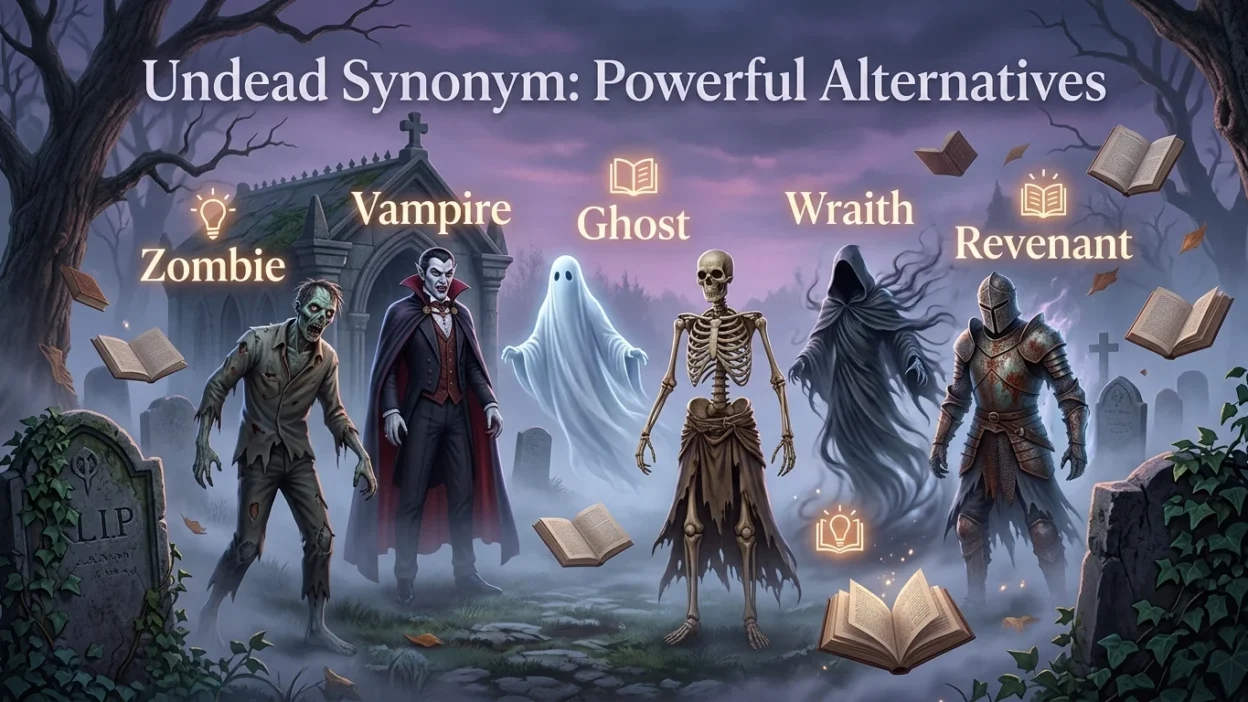
The word is commonly used for creatures such as zombies, vampires, ghosts, and skeletons that return from death or continue to exist after dying.
Tone: Horror, fantasy, supernatural, mythical
Usage Context: Stories, novels, games, movies, folklore, and creative writing
30 Synonyms of Undead
1. Zombie
Meaning: A dead person brought back to life, often without intelligence.
Example Sentence: The zombie slowly walked through the abandoned town.
Best Usage Context: Horror stories and films.
2. Vampire
Meaning: An undead being that survives by drinking blood.
Example Sentence: The vampire emerged from the castle after sunset.
Best Usage Context: Gothic fiction and fantasy.
3. Ghost
Meaning: The spirit of a dead person.
Example Sentence: Many villagers believed a ghost haunted the old house.
Best Usage Context: Supernatural stories.
4. Phantom
Meaning: A ghostly or mysterious spirit.
Example Sentence: A phantom appeared in the foggy forest.
Best Usage Context: Dramatic horror writing.
5. Specter
Meaning: A frightening ghost or spirit.
Example Sentence: The specter frightened everyone who saw it.
Best Usage Context: Dark fiction.
6. Apparition
Meaning: A sudden appearance of a ghostly figure.
Example Sentence: An apparition appeared near the ancient church.
Best Usage Context: Paranormal descriptions.
7. Wraith
Meaning: A ghost like spirit often associated with death.
Example Sentence: The wraith floated silently through the hallway.
Best Usage Context: Fantasy and dark fiction.
8. Revenant
Meaning: A dead person who returns to life.
Example Sentence: The revenant sought revenge on his enemies.
Best Usage Context: Mythology and fantasy.
9. Ghoul
Meaning: A creature that feeds on dead bodies.
Example Sentence: The ghoul lurked in the cemetery at night.
Best Usage Context: Horror literature.
10. Lich
Meaning: An undead magical being with great power.
Example Sentence: The lich guarded the ancient treasure.
Best Usage Context: Fantasy games and novels.
11. Skeleton
Meaning: Animated bones of a dead person.
Example Sentence: A skeleton warrior stood at the gate.
Best Usage Context: Fantasy and adventure stories.
12. Mummy
Meaning: A preserved dead body brought back to life.
Example Sentence: The mummy awakened from its tomb.
Best Usage Context: Ancient themed horror.
13. Spirit
Meaning: The non physical essence of a person.
Example Sentence: The spirit watched over the village.
Best Usage Context: General supernatural writing.
14. Shade
Meaning: A ghost or spirit of the dead.
Example Sentence: A lonely shade wandered the battlefield.
Best Usage Context: Mythological writing.
15. Poltergeist
Meaning: A spirit known for causing disturbances.
Example Sentence: The poltergeist threw objects across the room.
Best Usage Context: Paranormal stories.
16. Banshee
Meaning: A female spirit whose cry signals death.
Example Sentence: The banshee’s scream echoed through the valley.
Best Usage Context: Irish folklore.
17. Fiend
Meaning: An evil supernatural being.
Example Sentence: The fiend emerged from the darkness.
Best Usage Context: Horror and fantasy.
18. Demon
Meaning: A malevolent supernatural creature.
Example Sentence: The demon haunted the ancient ruins.
Best Usage Context: Religious and fantasy contexts.
19. Soul
Meaning: The spiritual part of a person.
Example Sentence: The lost soul searched for peace.
Best Usage Context: Spiritual discussions.
20. Haunt
Meaning: A ghostly presence that lingers.
Example Sentence: The haunt remained in the old mansion.
Best Usage Context: Ghost stories.
21. Walker
Meaning: A dead being that walks among the living.
Example Sentence: The walker approached slowly from the woods.
Best Usage Context: Zombie fiction.
22. Corpse Walker
Meaning: An animated dead body.
Example Sentence: The corpse walker emerged from the graveyard.
Best Usage Context: Dark fantasy.
23. Nightwalker
Meaning: A supernatural being active at night.
Example Sentence: The nightwalker disappeared before dawn.
Best Usage Context: Fantasy writing.
24. Deathless One
Meaning: Someone who cannot truly die.
Example Sentence: Legends spoke of a deathless one living forever.
Best Usage Context: Epic fantasy.
25. Immortal Spirit
Meaning: A spirit that exists eternally.
Example Sentence: The immortal spirit guarded the temple.
Best Usage Context: Mythological tales.
26. Restless Spirit
Meaning: A spirit unable to find peace.
Example Sentence: The restless spirit haunted the castle.
Best Usage Context: Ghost stories.
27. Shadow Being
Meaning: A dark supernatural entity.
Example Sentence: A shadow being watched from the corner.
Best Usage Context: Modern horror.
28. Otherworldly Entity
Meaning: A being from another realm.
Example Sentence: The otherworldly entity appeared suddenly.
Best Usage Context: Fantasy and science fiction.
29. Eternal Wanderer
Meaning: A being doomed to wander forever.
Example Sentence: The eternal wanderer crossed the empty desert.
Best Usage Context: Poetic fantasy.
30. Living Dead
Meaning: A dead being that continues to move and act.
Example Sentence: The living dead filled the abandoned streets.
Best Usage Context: Classic horror writing.
Comparison : When to Use Different Undead Synonyms
| Synonym | Tone | Best For |
| Zombie | Horror | Apocalyptic stories |
| Vampire | Gothic | Dark fantasy |
| Ghost | Neutral | General supernatural writing |
| Revenant | Mythical | Legends and folklore |
| Wraith | Dark | Fantasy novels |
| Lich | Powerful | RPGs and fantasy games |
| Ghoul | Scary | Horror fiction |
| Spirit | Neutral | Spiritual discussions |
| Skeleton | Adventure | Fantasy settings |
| Living Dead | Horror | Classic undead themes |
How to Choose the Right Synonym
For Horror Stories
Use words such as:
- Zombie
- Ghoul
- Specter
- Living Dead
- Corpse Walker
These words create fear and suspense.
For Fantasy Writing
Use words such as:
- Lich
- Wraith
- Revenant
- Nightwalker
- Deathless One
These terms fit magical worlds and epic adventures.
For Ghost and Paranormal Themes
Use words such as:
- Ghost
- Phantom
- Apparition
- Shade
- Poltergeist
These are ideal for supernatural and haunted settings.
For Mythology and Folklore
Use words such as:
- Banshee
- Revenant
- Spirit
- Eternal Wanderer
- Immortal Spirit
These words connect well with legends and ancient tales.
For Creative or Poetic Writing
Use words such as:
- Shadow Being
- Eternal Wanderer
- Deathless One
- Otherworldly Entity
These create a more imaginative and artistic tone.
Conclusion
Understanding the best undead synonym can greatly improve your vocabulary and writing. While undead is a broad term for beings that exist after death, each synonym carries its own unique meaning, tone, and usage. Words like zombie, vampire, ghost, revenant, and wraith work best in different situations and genres.
By learning these 30 alternatives and understanding when to use each one, you can write more clearly, creatively, and accurately. Whether you are a student, ESL learner, novelist, gamer, or content creator, choosing the right synonym will make your writing stronger and more engaging.