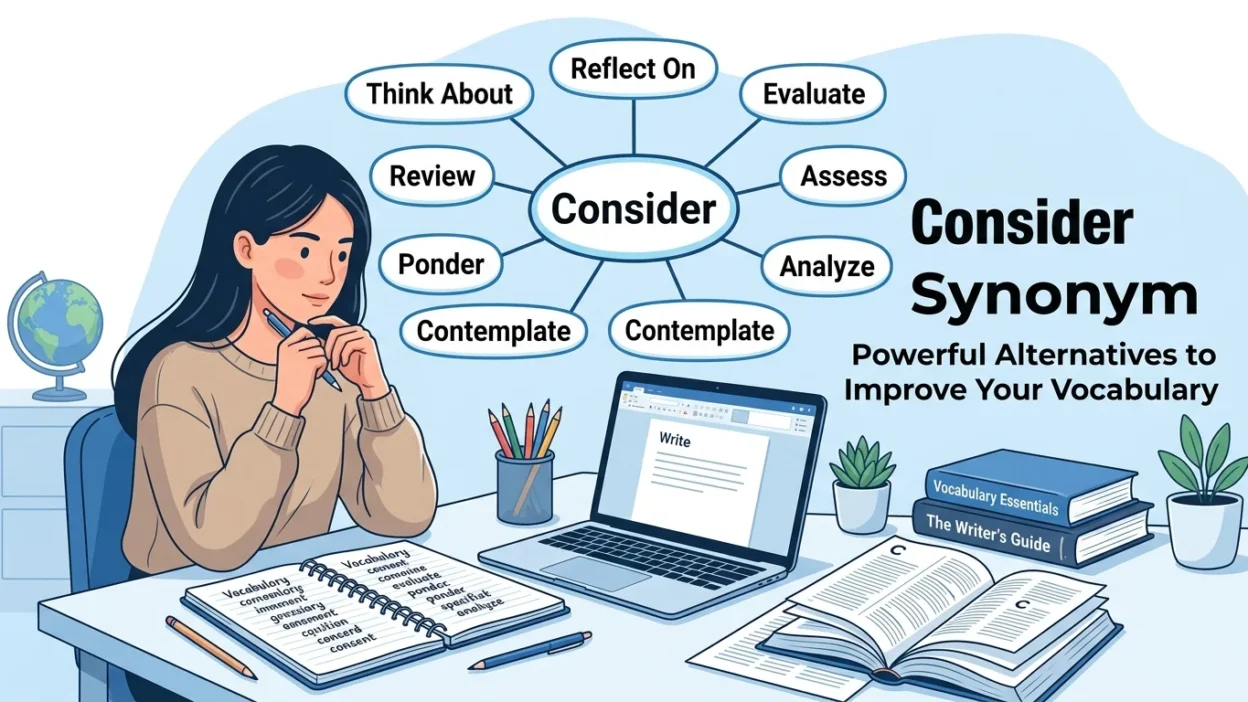
When writing or speaking in English, using the same word repeatedly can make your communication sound repetitive. One common word that often appears in conversations, essays, emails, and articles is consider. Learning a suitable consider synonym can help you express ideas more clearly and naturally.
Whether you are a student, ESL learner, writer, or content creator, understanding different words that can replace consider will improve your vocabulary and make your writing more engaging. Some synonyms are formal, while others are better suited for casual conversations. Knowing the difference helps you choose the right word in the right situation.
In this guide, you’ll learn the meaning of consider, explore 30 useful synonyms, see practical examples, and discover when each alternative works best.
What Does “Consider” Mean?
The word consider means to think carefully about something before making a decision, forming an opinion, or taking action.
It is commonly used when evaluating options, reflecting on ideas, or giving attention to a particular matter.
Example:
I will consider your suggestion before making a final decision.
Tone: Thoughtful, neutral, and professional.
Common Usage Contexts:
- Decision making
- Academic writing
- Business communication
- Everyday conversations
- Problem solving situations
30 Synonyms of Consider
1. Think About
Word: Think About
Meaning: To give attention to an idea or situation.
Example Sentence: Please think about my proposal before responding.
Best Usage Context: Everyday conversations.
2. Reflect On
Word: Reflect On
Meaning: To think deeply about something.
Example Sentence: She reflected on her experiences during college.
Best Usage Context: Personal growth and thoughtful writing.
3. Contemplate
Word: Contemplate
Meaning: To think carefully for a long time.
Example Sentence: He contemplated moving to another city.
Best Usage Context: Formal writing and serious decisions.
4. Evaluate
Word: Evaluate
Meaning: To judge the value or quality of something.
Example Sentence: The manager evaluated all available options.
Best Usage Context: Business and academic settings.
5. Examine
Word: Examine
Meaning: To inspect or study carefully.
Example Sentence: Scientists examined the results closely.
Best Usage Context: Research and analysis.
6. Review
Word: Review
Meaning: To look over something again.
Example Sentence: Please review the document before signing.
Best Usage Context: Workplace and education.
7. Assess
Word: Assess
Meaning: To determine the importance or quality of something.
Example Sentence: Teachers assess student performance regularly.
Best Usage Context: Professional and academic environments.
8. Analyze
Word: Analyze
Meaning: To study details carefully.
Example Sentence: Researchers analyzed the collected data.
Best Usage Context: Research and technical writing.
9. Ponder
Word: Ponder
Meaning: To think deeply about something.
Example Sentence: She pondered the question for several minutes.
Best Usage Context: Creative and reflective writing.
10. Deliberate
Word: Deliberate
Meaning: To discuss or think carefully before deciding.
Example Sentence: The committee deliberated for hours.
Best Usage Context: Formal decision making.
11. Study
Word: Study
Meaning: To examine closely.
Example Sentence: We studied the market trends carefully.
Best Usage Context: Academic and business use.
12. Inspect
Word: Inspect
Meaning: To check something carefully.
Example Sentence: Engineers inspected the bridge.
Best Usage Context: Technical and practical situations.
13. Investigate
Word: Investigate
Meaning: To examine thoroughly.
Example Sentence: Police investigated the incident.
Best Usage Context: Research and inquiries.
14. Scrutinize
Word: Scrutinize
Meaning: To examine very carefully.
Example Sentence: The editor scrutinized every detail.
Best Usage Context: Formal analysis.
15. Weigh
Word: Weigh
Meaning: To compare advantages and disadvantages.
Example Sentence: We must weigh the risks before investing.
Best Usage Context: Decision making.
16. Mull Over
Word: Mull Over
Meaning: To think about something for a period of time.
Example Sentence: He mulled over the offer all weekend.
Best Usage Context: Informal conversations.
17. Judge
Word: Judge
Meaning: To form an opinion.
Example Sentence: Try not to judge too quickly.
Best Usage Context: Opinions and evaluations.
18. Reconsider
Word: Reconsider
Meaning: To think about again.
Example Sentence: She reconsidered her original plan.
Best Usage Context: Revising decisions.
19. Appraise
Word: Appraise
Meaning: To evaluate value or quality.
Example Sentence: Experts appraised the property.
Best Usage Context: Professional assessments.
20. Debate
Word: Debate
Meaning: To think about competing choices.
Example Sentence: I debated whether to accept the offer.
Best Usage Context: Personal decisions.
21. Account For
Word: Account For
Meaning: To take something into consideration.
Example Sentence: We must account for unexpected expenses.
Best Usage Context: Planning and analysis.
22. Regard
Word: Regard
Meaning: To think of something in a certain way.
Example Sentence: Many regard him as a great leader.
Best Usage Context: Opinions and perceptions.
23. View
Word: View
Meaning: To see or think about something.
Example Sentence: I view this opportunity positively.
Best Usage Context: Personal opinions.
24. Think Over
Word: Think Over
Meaning: To consider carefully.
Example Sentence: Think over the proposal before deciding.
Best Usage Context: Everyday communication.
25. Meditate On
Word: Meditate On
Meaning: To focus deeply on a thought.
Example Sentence: He meditated on the meaning of success.
Best Usage Context: Personal reflection.
26. Gauge
Word: Gauge
Meaning: To estimate or evaluate.
Example Sentence: We need to gauge customer interest.
Best Usage Context: Business decisions.
27. Explore
Word: Explore
Meaning: To examine possibilities.
Example Sentence: Let’s explore other solutions.
Best Usage Context: Problem solving.
28. Question
Word: Question
Meaning: To think critically about something.
Example Sentence: She questioned the accuracy of the report.
Best Usage Context: Critical thinking.
29. Review Carefully
Word: Review Carefully
Meaning: To inspect thoroughly.
Example Sentence: Please review carefully before submitting.
Best Usage Context: Documents and reports.
30. Take Into Account
Word: Take Into Account
Meaning: To include a factor in thinking or planning.
Example Sentence: We should take weather conditions into account.
Best Usage Context: Planning and decision making.
Comparison Table: When to Use Different Consider Synonyms
| Synonym | Best For | Tone |
| Think About | Everyday conversations | Casual |
| Reflect On | Personal experiences | Thoughtful |
| Contemplate | Serious decisions | Formal |
| Evaluate | Business decisions | Professional |
| Assess | Performance reviews | Professional |
| Analyze | Research and data | Academic |
| Ponder | Deep thinking | Reflective |
| Deliberate | Group decisions | Formal |
| Weigh | Comparing options | Practical |
| Mull Over | Informal reflection | Casual |
How to Choose the Right Synonym
For Everyday Conversations
Use:
- Think About
- Think Over
- Mull Over
- Explore
These sound natural and friendly.
For Academic Writing
Use:
- Analyze
- Assess
- Examine
- Evaluate
- Study
These words sound precise and professional.
For Formal Business Communication
Use:
- Deliberate
- Review
- Appraise
- Gauge
- Assess
These are suitable for reports, meetings, and professional emails.
For Deep Reflection
Use:
- Reflect On
- Ponder
- Contemplate
- Meditate On
These express careful and thoughtful thinking.
For Decision Making
Use:
- Weigh
- Evaluate
- Debate
- Reconsider
- Take Into Account
These work well when comparing choices or making plans.
Conclusion
Understanding a good consider synonym can make your English more varied, professional, and engaging. While consider is a useful word, alternatives such as think about, evaluate, reflect on, analyze, and weigh can express more specific meanings depending on the situation.
The key is to match the synonym with your purpose. Use casual alternatives in conversations, professional alternatives in business writing, and reflective alternatives when discussing personal thoughts. By practicing these 30 synonyms regularly, you’ll expand your vocabulary and communicate with greater confidence and precision.